

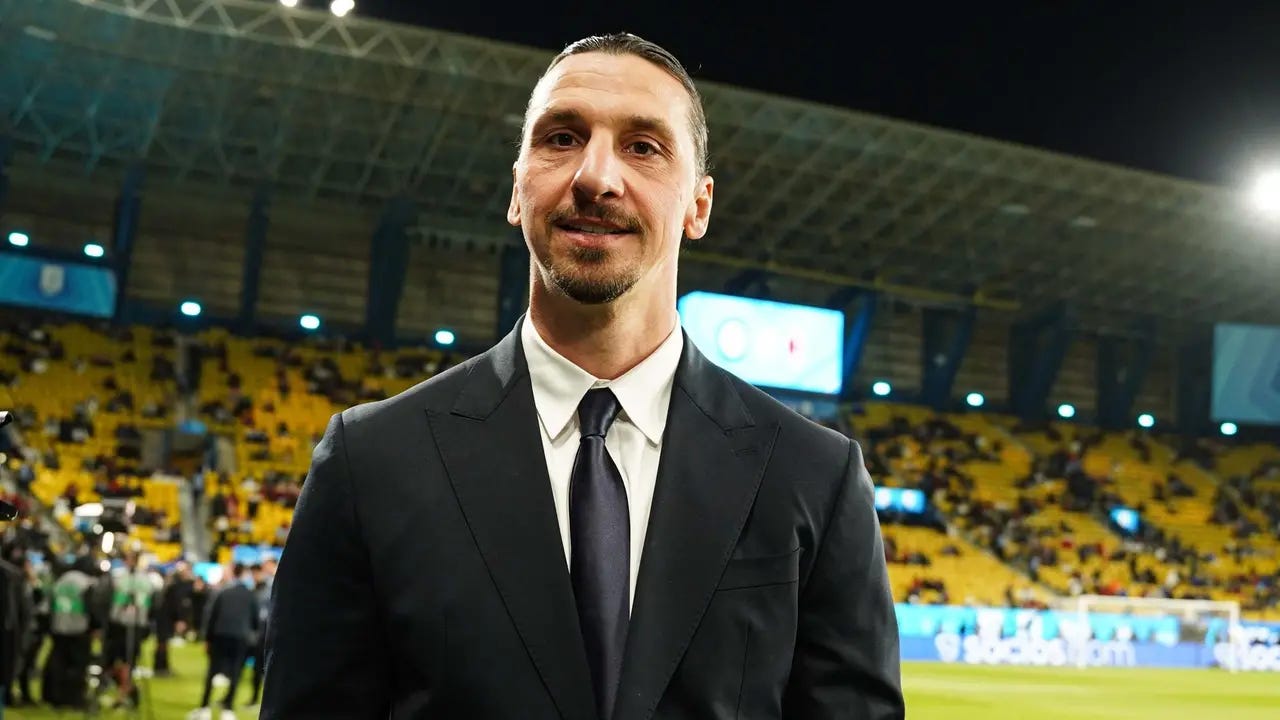
Zlatan Ibrahimovic turns 45 today, and there is something fitting about the fact that he still cannot keep out of the headlines. Three years after he hung up his boots at AC Milan, the Swede remains one of the most talked about figures in Italian football, only now the arguments are about boardroom influence and ownership structures rather than touchline strops and audacious finishes. Few careers in the modern game have refused to fade quietly, and Ibrahimovic’s second act has turned out to be almost as eventful as his first.
Born in Malmö on 3 October 1981, Ibrahimovic built a playing career that spanned four decades and eleven clubs across five countries, a feat of longevity as much as talent. He began at his hometown club before Ajax gave him his first taste of major silverware, winning two Eredivisie titles before a move to Juventus. Three Serie A championships followed at Inter Milan, won back to back to back, before a difficult year at Barcelona under Pep Guardiola that he always spoke about with more bitterness than most of his other stops.
It was at AC Milan where he first properly fell in love with a club, winning the title in his debut season in 2010 and following it with a Serie A top scorer award the following year. Paris Saint Germain gave him the platform to become a genuine global superstar, scoring 113 goals in four seasons and lifting four consecutive Ligue 1 titles, numbers that still make him the club’s all time leading scorer. A combative spell at Manchester United brought an EFL Cup and a Europa League, cut short by a serious knee injury, before a remarkable late career swansong in Los Angeles with the Galaxy, where he reached 500 career goals and was named to the MLS Best XI in both of his seasons there.
Numbers alone never explained the pull of Ibrahimovic, though. He built a reputation as one of football’s great self mythologisers, happy to refer to himself in the third person and to treat press conferences as theatre rather than obligation, and supporters who never saw him play for their own club still knew exactly who he was. That ability to dominate a room without saying very much of substance has, as it turns out, translated rather neatly into his life after playing.
The Return That Defined His Legacy
His second spell at AC Milan, beginning in January 2020, is the one supporters in Italy remember most fondly. Ibrahimovic helped drag a club that had spent years adrift back towards the top of Serie A, and the 2021 to 2022 title win, Milan’s first in eleven years, owed a genuine debt to his presence in the dressing room even as his body visibly slowed him down. He became the oldest goalscorer in the history of the Derby della Madonnina against Inter, and he finally retired at the end of the 2022 to 2023 season having scored more than 570 goals across club and country and collected 34 major trophies.
International recognition followed the same pattern of stubborn excellence. He finished his Sweden career with 122 caps and 62 goals, both national records, and provided the single moment that will forever define him in the eyes of neutral football fans: the 35 yard bicycle kick against England at Friends Arena in November 2012, scored from an almost impossible angle and voted the finest goal of that calendar year. He also won the Guldbollen, Sweden’s award for the country’s best player, a remarkable 12 times across his career.
From Dressing Room to Boardroom
What has made the past three years genuinely fascinating is how little Ibrahimovic has actually left football behind. Within months of retiring he was appointed Senior Advisor to Ownership and Operating Partner at AC Milan, working directly for Gerry Cardinale’s RedBird Capital Partners rather than the club itself, a distinction that has mattered a great deal. According to Gazzetta dello Sport, he has since acquired a shareholding stake in RedBird’s fund, an offer Paolo Maldini had reportedly turned down before him, and he has taken an increasingly hands on role in recruitment, reportedly pushing internally last year for Milan to pursue Robert Lewandowski from Barcelona.
That influence was tested properly in May, when Milan sacked head coach Massimiliano Allegri along with the club’s sporting hierarchy, including Igli Tare, Giorgio Furlani and Geoffrey Moncada, after missing out on Champions League qualification again. Ibrahimovic was the only senior figure to survive the clear out, in part because his position with RedBird rather than Milan directly means the club cannot simply dismiss him. Ruben Amorim, fresh from his own sacking at Manchester United, arrived in June as the new head coach, and Ibrahimovic has reportedly taken an even more prominent role in the subsequent squad rebuild.
There was brief speculation over the summer that his position might shift towards something more commercially focused and based in the United States, but that talk has since been played down, with reports from Italy describing his relationship with Cardinale as stronger than ever rather than strained. For a man once defined by his unwillingness to sit quietly on a substitute’s bench, a seat at the top table clearly still suits him.
Still Impossible to Ignore
That is the enduring thread running through Ibrahimovic’s story. Whether scoring against England with his back to goal, strutting around Los Angeles proclaiming his own arrival, or now shaping transfer policy from the boardroom at San Siro, he has never once been a peripheral figure in any room he has occupied. Forty five years old and three years retired, and Italian football is still talking about him every single week. Few players manage that while they are playing. Fewer still manage it after they have stopped.
Happy birthday to one of the most singular characters the game has ever produced. If stories like this one are your sort of thing, consider following It Was Always… Football for more of the game’s best characters, past and present.