

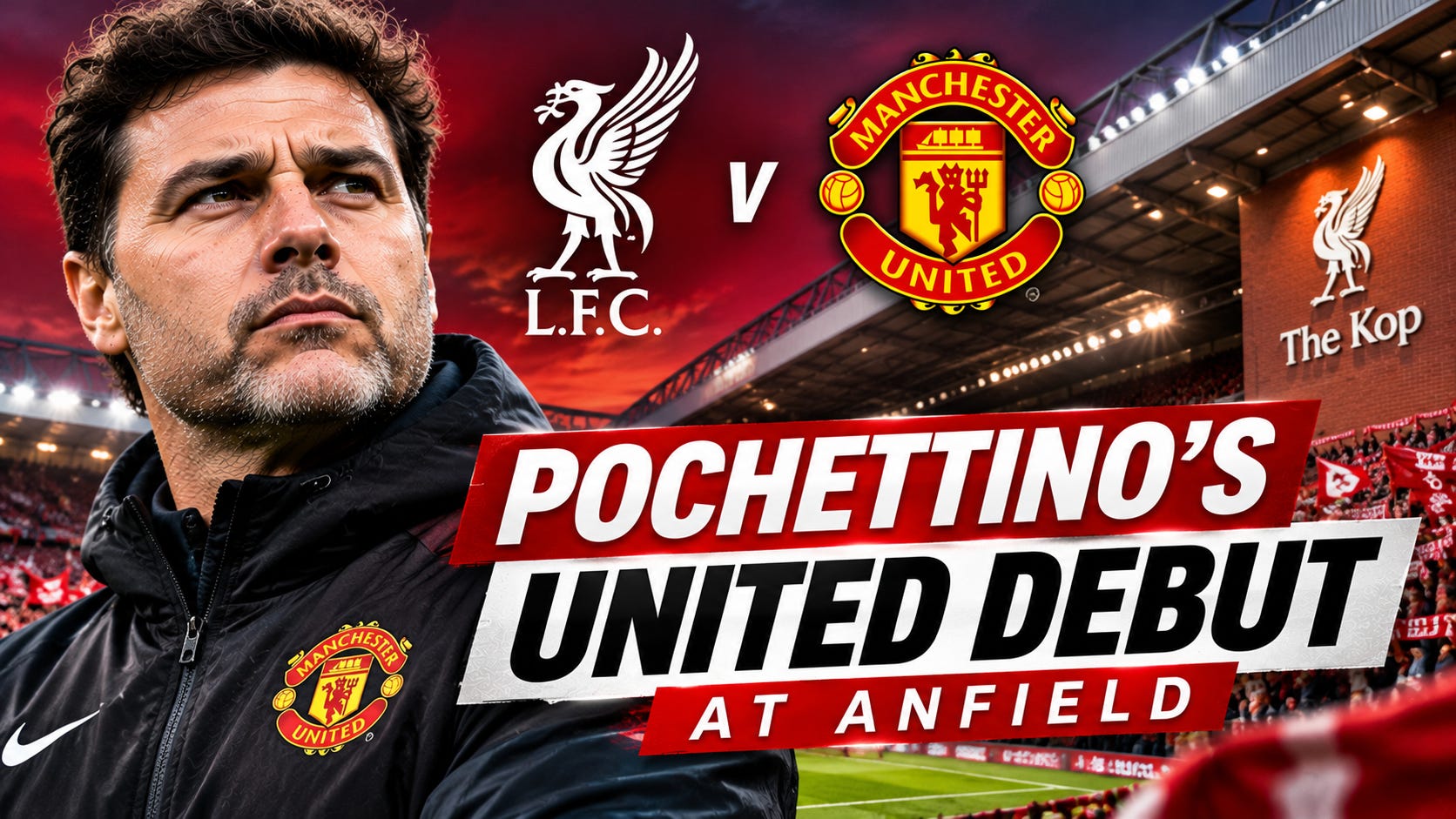
Mauricio Pochettino will take charge of Manchester United for the first time on Sunday, and there was never any chance of a gentle introduction. His side travel to Anfield for a 4.30pm kick off, live on Sky Sports, with United sitting 18th in the Premier League and Liverpool waiting in 4th. It is, by any measure, about as hard an opening fixture as English football could have handed him.
The timing alone tells its own story. United sacked Michael Carrick on 12 November, barely an hour before Crystal Palace dismissed Pierre Sage. Pochettino was confirmed as Carrick's successor the following day on a contract running to the summer of 2029, but he could not simply walk into Old Trafford and get to work. He was still in charge of the United States national team, with a Concacaf Nations League quarter final against Haiti to finish first. Only after that commitment was done, following a 6-0 first leg win and a 2-0 second leg victory, did he fly to Manchester to begin life at his new club.
A debut built around three days of training
That scheduling quirk means Pochettino has had, at most, Thursday, Friday and Saturday on the training pitch with his new squad before facing one of the most demanding away trips in the country. It is a situation he has addressed directly rather than tried to talk around. Asked about the scale of the job awaiting him, his response was short and pointed: "You will see. Give me time."
He has been more expansive elsewhere about what he wants to build. "The new challenge is a big challenge, but at the same time, it's adrenaline you want to feel," he said of walking into a club he knows carries expectations far beyond its current league position. "We know the situation is not a situation that deserves to be a club like Manchester United, the fan base is amazing." His emphasis since arriving has been less on tactics and more on culture: "Football is about attitude, and it's about the approach. It's about connection, feelings and communication."
Whether three days is remotely enough to instil any of that before facing Liverpool is, inevitably, the question hanging over the weekend. United have not won in four matches, a run that cost Carrick his job, and their most recent result before the international break was a chaotic 4-4 draw with Aston Villa. They sit on eight points from ten games, their worst start to a season since 1986/87, the campaign in which Alex Ferguson arrived as manager. That comparison offers the only real crumb of historical comfort, given how differently things eventually turned out at Old Trafford that time around.
A ground that has rarely been kind to him
If the circumstances were not difficult enough, Pochettino arrives at a stadium where his own managerial record makes for grim reading. Across spells at Southampton, Tottenham and Chelsea, he has faced Liverpool nineteen times as a manager, more than against any club bar Manchester City. The return is three wins, five draws and eleven defeats, with twenty goals scored and thirty three conceded. At Tottenham specifically, the club with which he is most associated, he won just once in thirteen attempts against them.
The victories, when they have come, have tended to be spectacular rather than routine. Southampton beat Liverpool 3-1 in 2013 and then won 1-0 at Anfield itself the following season. His finest result against them arrived with Tottenham in 2017/18, a 4-1 win at Wembley built on an early Harry Kane and Son Heung-min flurry that Liverpool never recovered from. Set against that are harder memories: a Champions League final defeat to Liverpool in 2019, a 4-1 beating at Anfield while he was in charge of Chelsea, and a Carabao Cup final loss after extra time in 2024. It is a fixture that has produced his best nights and some of his worst, rarely anything in between.
The opponent he is walking into
Liverpool themselves arrive at this game in considerably better shape than the team Pochettino is attempting to rescue. Andoni Iraola took over in the summer after Arne Slot's exit and has settled his side into the top four, with Alexander Isak the division's second highest scorer behind only Erling Haaland heading into the international break. There is little reason to expect Liverpool to offer Pochettino any charity in his first ninety minutes, whatever sympathy there might be around English football for the scale of the job he has taken on.
There is, at least, one striking historical quirk working in United's favour, however faint the comfort. This will be the latest point in a Premier League season that these two clubs have met with one side sitting in the relegation zone since November 1972, when a bottom placed Manchester United beat a Liverpool side top of the table 2-0 at Old Trafford. Pochettino's United are a long way from believing in omens just yet, but it is the sort of statistic a struggling club will happily cling to in the days before kick off.
What a result either way would actually mean
A win would do far more than lift United off the foot of the table. It would hand Pochettino's tenure the kind of immediate credibility that his predecessor never managed to build, and buy him real patience from supporters who have watched four managerial eras come and go without the club looking anything like itself. A heavy defeat, by contrast, would simply confirm the scale of the rebuilding job in front of him before he has had a fair chance to shape it, and reopen every question that followed Carrick's dismissal.
What seems certain is that nobody inside Old Trafford expects instant transformation from a manager who has barely had time to learn his players' preferred positions, let alone build a system around them. Pochettino has asked, repeatedly and in different words, for exactly what every new manager in his position wants: time. Anfield on Sunday will not grant him much of it, but it will offer the first genuine evidence of whether this appointment can work.
If stories like this are the reason you follow the Premier League through its toughest moments as closely as its triumphant ones, there is always more at It Was Always... Football. Subscribe or follow along to keep up with how the next chapter unfolds.