

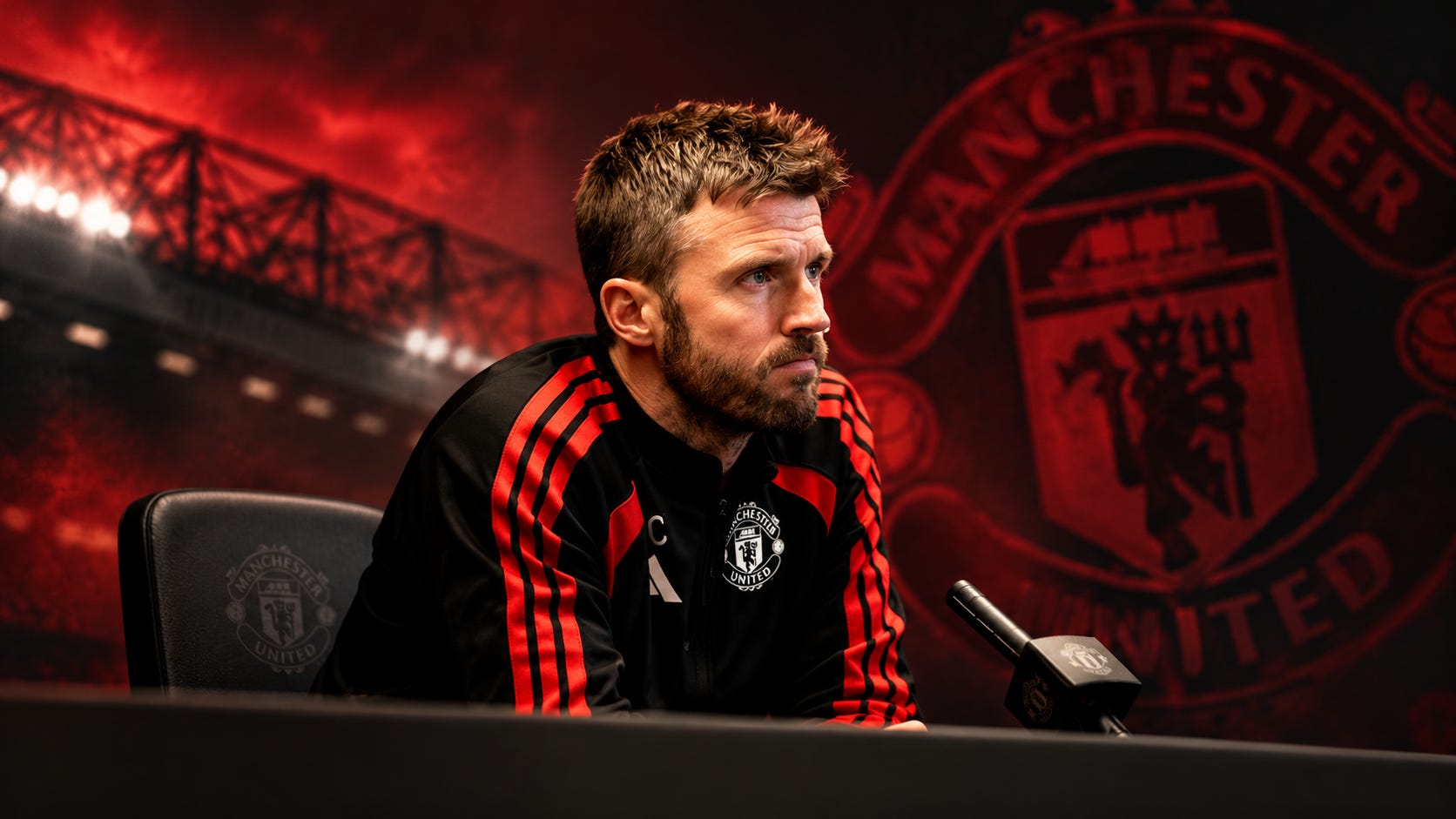
Michael Carrick walked into his media briefing at Carrington and, without being asked a single question, delivered an unprompted monologue lasting more than five minutes. It arrived after one of the worst weeks of his time in charge: a 4-1 Champions League defeat away at Como on Wednesday, in which United trailed inside two minutes and were four goals down before Joshua Zirkzee’s stoppage time consolation, and a round of comments from captain Bruno Fernandes that appeared to question the coaching staff’s approach to that game. United have now won only two of their last 11 matches in all competitions and sit 13th in the Premier League, seven points from seven games, with a squad that looked, by Carrick’s own admission, in need of a reminder of what the shirt is supposed to mean.
What followed was not a defence of a tactical plan or a breakdown of Como’s pressing triggers. It was an argument about identity, delivered by a manager whose own position has rarely looked shakier.
A speech about humility, not about football
Carrick’s central theme was earned success rather than assumed success. “We need to respect what it takes to be here,” he said, before going further: “Entitlement cannot be at this football club.” He framed the club’s history, the trophies and the famous names, as something that had to be lived up to rather than leaned on. “It comes down to humility,” he added, insisting supporters “need to feel that” from the players wearing the shirt.
It was a pointed message, delivered days after Lisandro Martinez had publicly criticised director of football Jason Wilcox’s recruitment work and barely a week after Gary Neville had warned that Carrick’s own position could come under serious scrutiny by January if results did not improve. Rather than retreat from the pressure, Carrick leaned into it. Asked directly whether he believed he could turn the situation around, he did not hesitate. “100%, yeah,” he said, adding that he had already spoken with both the club’s hierarchy and his players. “The responsibility for me to be in this position is to lead.”
Giggs, Rooney and Ferguson as a lesson in perspective
The most striking part of the press conference was Carrick’s decision to invoke some of the biggest names in the club’s history, not to borrow their authority but to make the opposite point. “It was never about Ryan Giggs, it was about Manchester United,” he said of one of the most decorated players the club has produced, adding that “Manchester United is always bigger than any individual.” He pointed to Wayne Rooney as an example of a forward who sacrificed personal glory for the team, and suggested Sir Alex Ferguson’s defining quality was that the club always came before any individual achievement. He went back further still, to Sir Matt Busby and Sir Bobby Charlton, and the resilience it took to rebuild Manchester United after the Munich air disaster.
It was a deliberate choice of reference points. By reaching for the club’s most celebrated figures and framing all of them as servants of something bigger than themselves, Carrick was drawing a direct contrast with a current squad he clearly believes has drifted from that standard. He was equally direct in rejecting suggestions of a split dressing room. “It’s not divided,” he said. “We just need to get back to doing what we do best, and we will.”
The Fernandes question he would not answer
Carrick’s toughest moment came when he was pressed on his captain. Fernandes had criticised the team’s approach to the Como game in comments to Sky Italia, and speculation has grown over whether he should keep the armband for Sunday’s match. Asked outright whether he would consider stripping Fernandes of the captaincy, Carrick refused to offer any guarantee. “I will always do what is best for the football club,” he said, declining to confirm whether he had even spoken to his captain about the comments. “I don’t think this is the time to go into too much detail.”
That answer mattered. Reports elsewhere have suggested Fernandes will keep the armband and will not be fined, but those assurances have come from club sources rather than from Carrick himself in public. Leaving the question open, rather than shutting it down, kept the story alive heading into the weekend and added an extra layer of intrigue to a team selection that already had plenty riding on it.
What is actually waiting on Sunday
For all the talk of history and humility, Carrick’s words will mean little if United do not start winning matches again, and Bournemouth at Old Trafford on Sunday is where that process needs to begin. Kick off is 2pm, with Sky Sports Main Event showing the match as the clocks change for winter.
United’s team news only adds to the sense of a squad under strain. Kobbie Mainoo and Luke Shaw remain out, along with Patrick Dorgu and Manuel Ugarte, while Benjamin Sesko is a doubt with a shin issue. There is slightly better news in the possible returns of Marcus Rashford and Lisandro Martinez, and Ayden Heaven could also be available again after illness. Bournemouth, managed by Marco Rose and still searching for consistency of their own in the bottom half of the table, will have Junior Kroupi available after a foot problem, with Alex Toth their main absentee.
None of that changes the basic equation facing Carrick. He has made his case publicly, invoking the club’s greatest names to remind his players what is expected of them, and he has made clear he sees leadership as his responsibility rather than anyone else’s. Now it has to show up in the one place that still decides a manager’s fate: the scoreline. A response on Sunday would go a long way to turning Friday’s words into something more than a well delivered speech. Another defeat would make them very hard to repeat with a straight face.
If you enjoyed this, consider following It Was Always… Football for more on the stories shaping the game, on and off the pitch.