

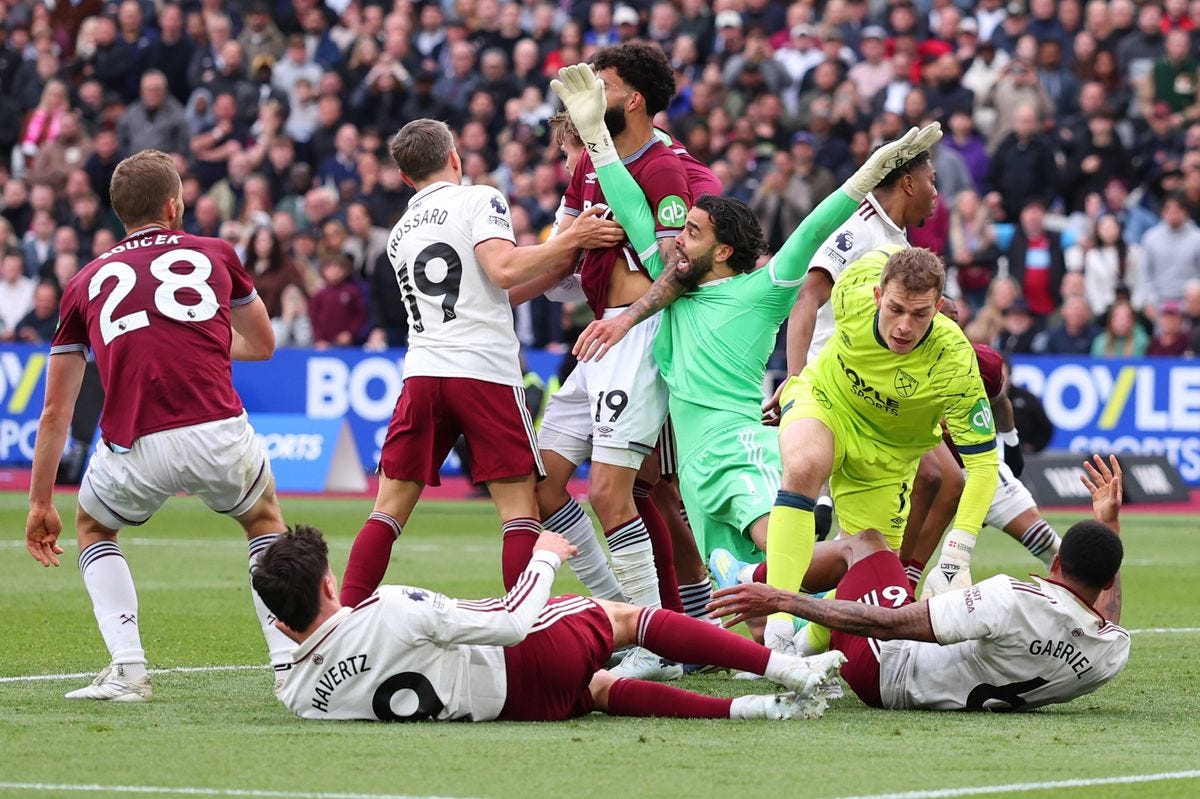
Arsenal have probably just won the Premier League. That is the reality after a 1-0 win at West Ham that was tense, ugly, vital and drenched in controversy.
Two games remain. Burnley at home. Crystal Palace away. Arsenal are five points clear, and the finish line is close enough for their supporters to taste it. After 22 years without a league title, nobody in red and white will care whether this victory came wrapped in silk or dragged through the mud.
Nor should they. Titles are not won by asking permission. They are won by surviving days like this.
Leandro Trossard scored the goal. Martin Odegaard changed the game from the bench. David Raya made the save that may live in Arsenal memory for decades. Then VAR took centre stage in stoppage time, with Callum Wilson’s equaliser ruled out after Pablo was judged to have impeded Raya at a corner.
Here is the awkward truth. Raya was fouled.
Here is the bigger truth. That does not clear up the controversy. It deepens it.
Because this was not one clean decision in a clean season. It was a correct call dropped into a campaign where goalkeepers have been shoved, blocked, grabbed, crowded and dragged around with very little protection. Arsenal know that better than most. They have profited from that grey area all season.
That is why the anger is not simply anti Arsenal noise. It isn’t jealousy dressed up as analysis. It is about consistency. It is about PGMOL. It is about a league where the definition of a foul seems to change when the stakes are highest.
VAR controversy was about consistency, not Arsenal
Arsenal did nothing wrong by accepting the decision. Let us be clear about that. They did not operate the VAR. They did not send Chris Kavanagh to the monitor. They did not set the threshold for goalkeeper contact. They played the game in front of them and won it.
Yet Arsenal supporters cannot treat the Raya foul as if it lives in isolation.
They have been one of the best set-piece teams in the country. That is partly because they are well coached, brave, organised and ruthless. It is also because they have worked expertly inside a refereeing climate where penalty boxes have become wrestling zones. Screens, blocks, nudges, holds, goalkeeper crowding, all of it has become part of the modern Premier League corner.
Arsenal have used that climate brilliantly. They have also benefited from it.
That is where the argument bites. If pulling Raya’s arm and blocking his movement is a foul at West Ham in May, why has similar contact on goalkeepers so often been allowed across the season? Why have goals stood when keepers have been pinned, barged or held? Why has contact that looked illegal in August, September and January suddenly become decisive with the title race and relegation battle on the line?
Nobody serious can say Pablo did nothing. He clearly impeded Raya. The problem is that the Premier League has spent too long telling players, through inaction, that this kind of chaos will often be tolerated.
Then came this moment. A goal ruled out. Arsenal protected. West Ham punished. PGMOL exposed again.
That is why the decision feels so combustible. It was right by the book, yet wrong by the season’s pattern.
That is the most damaging kind of officiating. It leaves everybody with an argument and nobody with trust.
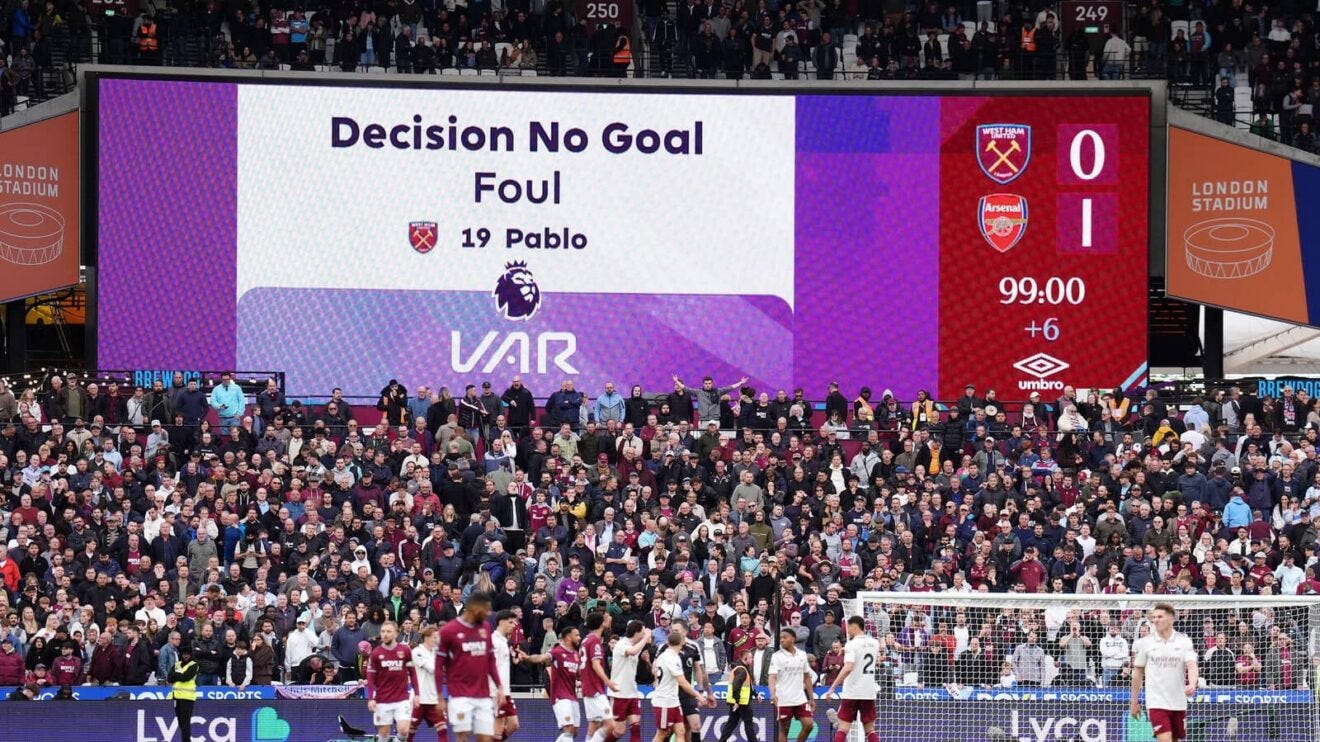
Arsenal benefited, West Ham had penalty claims
The foul on Raya was not the only offence in that penalty area. That point matters.
The stoppage time corner was not a single incident. It was a brawl in football kit. Raya was impeded by Pablo, yes. Around them, Arsenal and West Ham players were grabbing, blocking and tangling all over the place. Declan Rice had contact with Konstantinos Mavropanos. Martin Odegaard was involved with Jean Clair Todibo. Kai Havertz and Tomas Soucek were wrestling each other down. There was enough going on for VAR to justify almost anything if it looked long enough.
That’s the madness.
Disallow the goal for the foul on Raya? Yes, that can be defended.
Award West Ham a penalty for Arsenal holding? That could also have been defended.
Give nothing and say this is the kind of mess officials have allowed all season? That would have been consistent with plenty of Premier League weekends.
This is why West Ham’s frustration deserves more than a shrug. Their complaint is not that Raya was untouched. Their complaint is that Arsenal players were also committing offences in the same phase, and VAR chose one act of illegality above the rest.
Once the referee is sent to the monitor, the idea that only one foul matters becomes difficult to sell. If the box contains several fouls, why does the one against Arsenal become decisive while possible fouls by Arsenal are treated as background noise?
That question will not go away.
It becomes louder because Arsenal’s domestic disciplinary record has become part of the wider conversation. No Premier League penalties conceded. No Premier League red cards. Across a whole season, for a side that defends aggressively, attacks set pieces physically and plays on the edge, that is extraordinary.
It does not prove favouritism. It does not make Arsenal cheats. It does not invalidate their title charge.
It does, though, invite scrutiny.
When a team can be so physical, so intense and so dominant in contact areas, yet still avoid the two biggest punishments in the league across an entire campaign, supporters of other clubs will ask questions. They will ask them even louder when a match-defining VAR call lands in Arsenal’s favour at the most important point of the season.
Arsenal fans may not like that. They don’t have to. But the question is fair.
For West Ham, the pain is obvious. A late equaliser against the league leaders would have been enormous. It would have changed the mood, the table and perhaps the survival fight. Instead, the goal vanished after a long review, and they were left with fury, regret and another defeat.
They will also look back at Mateus Fernandes’ chance before Trossard scored. That was the moment. West Ham cut through Arsenal, Fernandes had the chance to finish, and Raya stood tall. It was a brilliant save, although West Ham will know it should have been a goal. In relegation fights, those misses are fatal.
VAR hurt West Ham. Their own finishing hurt them too.
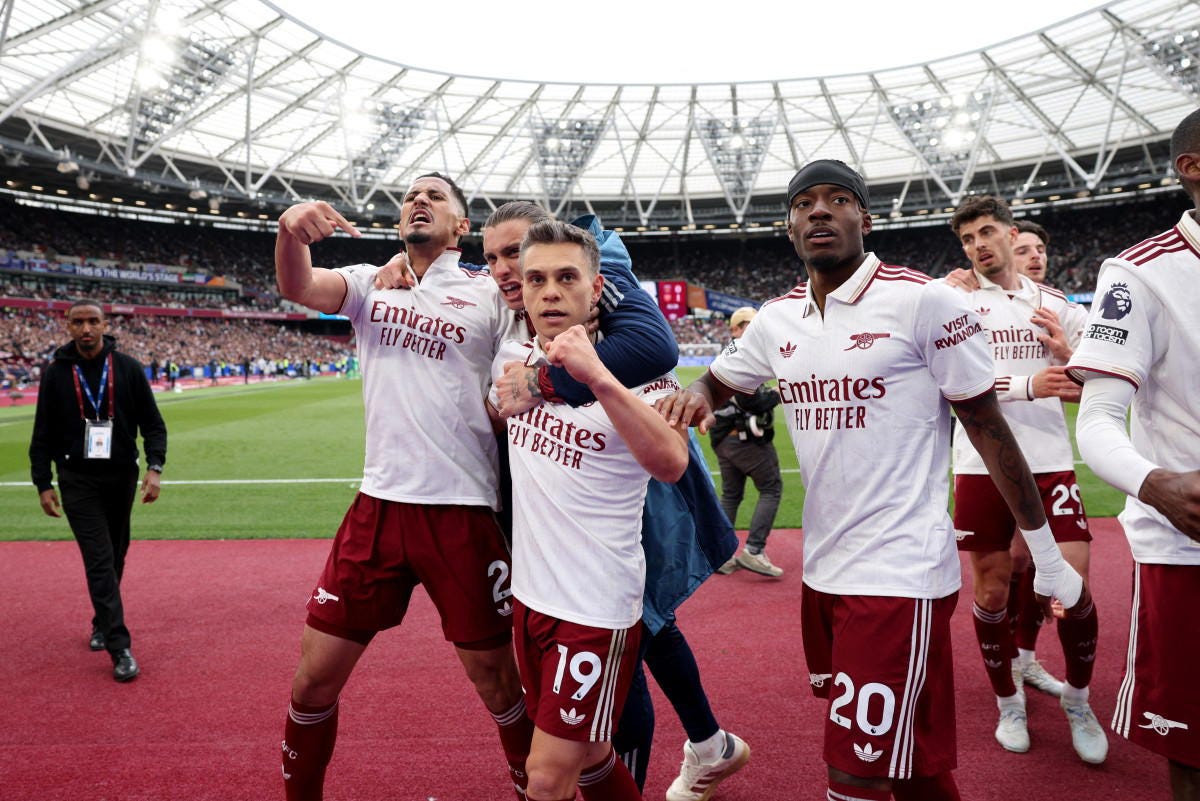
Raya, Trossard and Odegaard delivered champion moments
For all the controversy, Arsenal still had to win the match. That should not be forgotten.
This was a horrible fixture for a title challenger. West Ham were desperate, compact and backed by a crowd that understood the stakes. Arsenal started well, then lost some control after Ben White’s injury. Mikel Arteta’s reshuffle was messy. Declan Rice at right back felt awkward. The balance changed. West Ham grew. The match began to tilt towards the kind of late-season ordeal that can swallow title dreams whole.
Arsenal did not play beautiful football. They did not need to.
This team has become expert in hard edges. They manage space. They defend their box. They rarely panic. They have the look of a side that trusts its structure even when the game gets wild.
Raya’s save from Fernandes was immense. Not flashy for the sake of it. Not theatrical. Just decisive. He stayed up, waited, read the finish and kept Arsenal level. Saves like that alter the course of seasons. If Arsenal lift the trophy, that moment will sit alongside any goal from the campaign.
Then came Odegaard.
He came off the bench and brought clarity. Arsenal had been searching for a clean attacking moment and he gave them one. His involvement before Trossard’s goal was sharp, calm and imaginative. Trossard still had work to do, and his finish, with a deflection, was enough.
Enough is the key word now.
Arsenal do not need to win hearts in May. They need to win matches. This was a 1-0 away victory under extreme pressure, against a team fighting for survival, with the title almost within reach. That is not luck. That is steel.
Some will call them pragmatic. Some will call them dull. Some will say they have squeezed too many narrow wins from set pieces, structure and refereeing fortune. Arsenal supporters will point at the table.
And the table is the only witness that matters when trophies are handed out.
If Arsenal finish the job, they will have earned the title across 38 matches. Not because of one VAR decision. Not because of one late escape. Because they have been consistent, resilient and harder to beat than everybody else.
Still, this victory will carry an asterisk in public debate. Not an asterisk against Arsenal’s achievement, but against the league’s officiating culture.
That is PGMOL’s burden, not Arsenal’s.
PGMOL must fix the goalkeeper chaos
The Premier League cannot keep going like this.
Set pieces have become too important and too lawless. Every corner now looks like a test of how much holding the referee can ignore. Players block keepers, defenders hold attackers, attackers drag defenders, everybody appeals, and VAR enters after the fact like a tired lawyer trying to reconstruct a street fight.
It is grim. It is confusing. It is avoidable.
PGMOL needs a clear line next season. If goalkeepers are protected, protect them properly. If blocking a keeper’s movement is a foul, give it every week. If holding in the box is illegal, punish it early in the season until players stop doing it. There may be a burst of penalties. Fine. Let the game adjust.
What cannot continue is this selective enforcement.
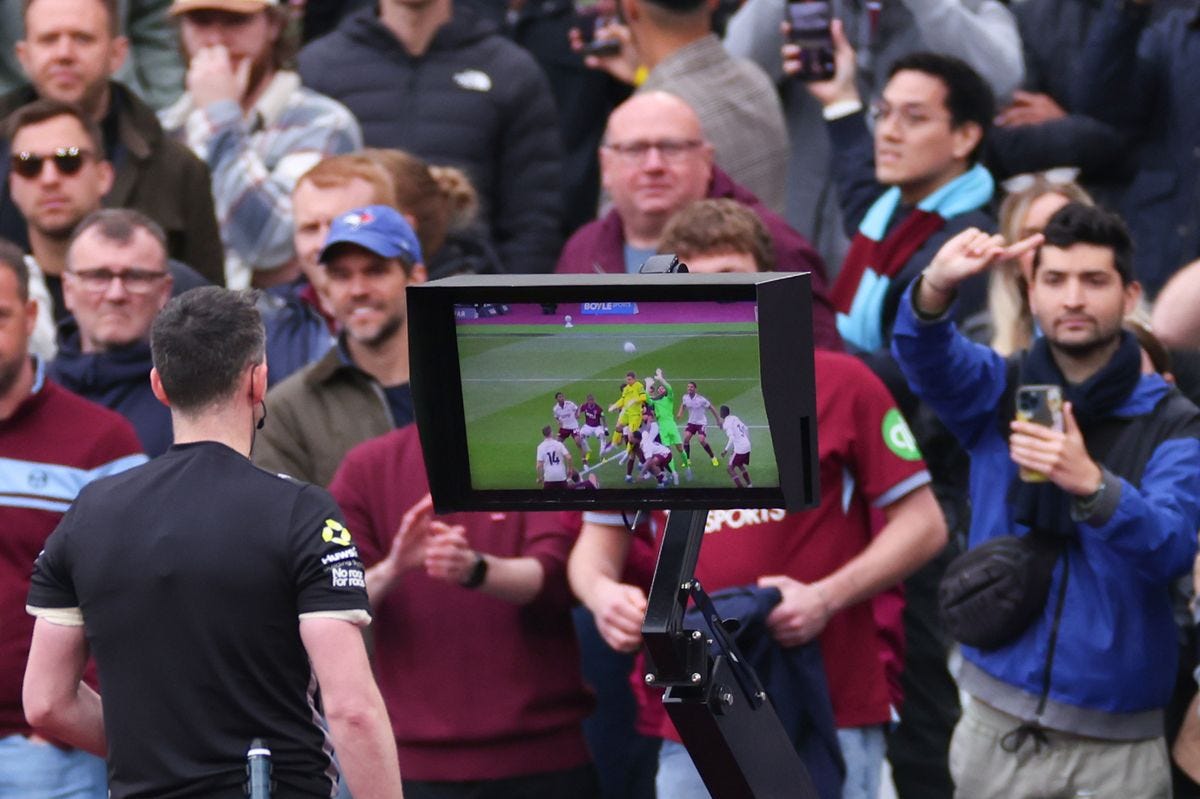
Football people do not demand perfection. They know officials will make mistakes. They know VAR cannot remove judgement from a subjective sport. What they want is a recognisable standard. A foul in August should still be a foul in May. A foul by Arsenal should be treated like a foul against Arsenal. A penalty area should not operate under different laws depending on the noise around the match.
This was the worst possible fixture for PGMOL to rediscover strictness. Arsenal chasing the title. West Ham fighting relegation. A late goal. A long review. Multiple fouls in the box. One selected offence. One disallowed equaliser.
The decision may have been correct. The process still felt rotten because the season around it has been rotten.
Arsenal will not care tonight. They’re almost there. Their supporters can see the trophy, even if the club will sensibly pretend otherwise until the job is finished. They have Burnley and Palace between them and history, and they have every reason to believe this is their time.
West Ham will care deeply. They may look back at this game as one of the moments that pushed them towards the Championship. Relegation, if it comes, will not be caused by one VAR call. Their season has carried too many dropped points, missed chances and poor performances for that. But this decision will sting because it felt like the rules finally mattered at the exact moment they hurt West Ham most.
That’s the cruelty.
Raya was fouled. Arsenal were also lucky. West Ham had reason to feel robbed. PGMOL followed the law in one incident while exposing the lack of law across a whole season.
Arsenal march towards the title. West Ham rage towards the run-in. PGMOL leaves everyone arguing again.
And the question remains painfully simple.
What exactly is a foul in the Premier League?
Interesting in that in the past two seasons the winning total is c85 points. Strongly points to the highly competitive nature of the PL. In any case next year perhaps the rules will change and Arsenal will require other ways of winning beyond set-piece supremacy.