

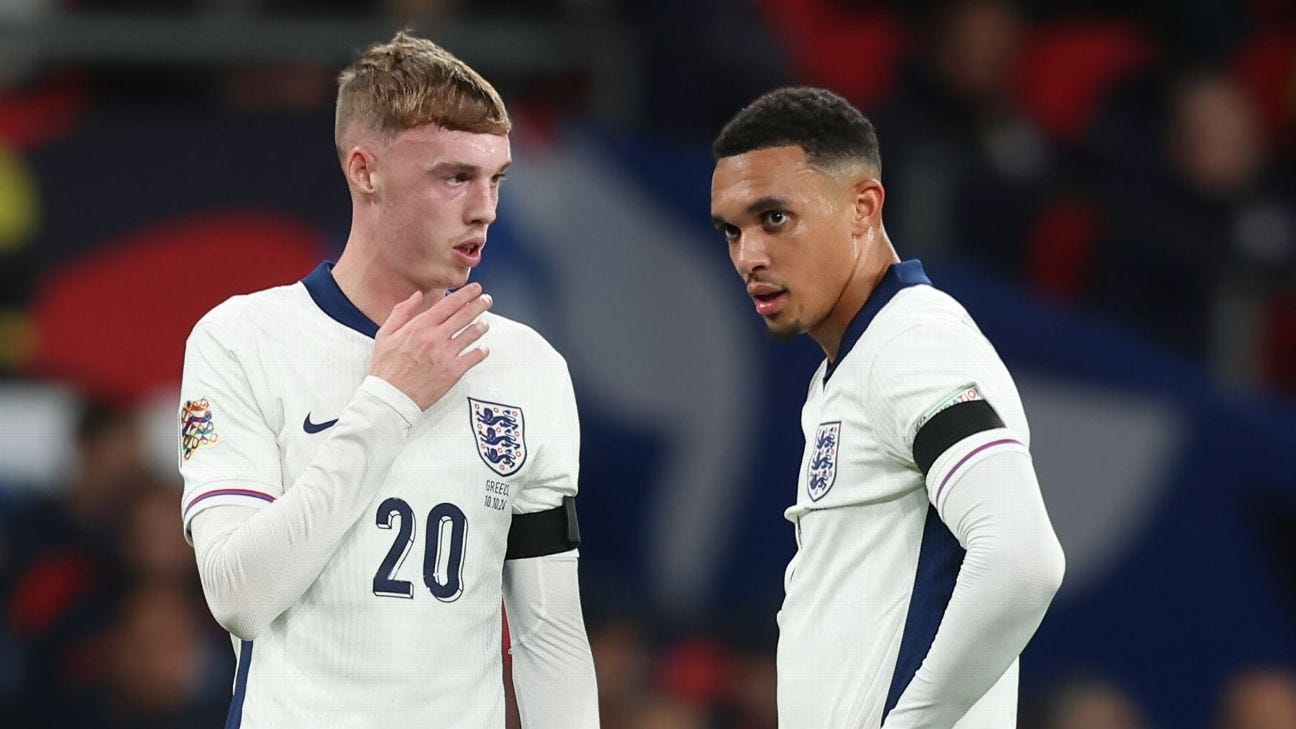
Thomas Tuchel has recalled Trent Alexander-Arnold and Cole Palmer to his England squad for this month’s Nations League fixtures, bringing both players back into the fold just months after they were left out of the group that finished third at the 2026 World Cup.
The 27 man squad was named for a busy block of four games. England host Spain on 26 September, travel to face Czechia three days later, take on Croatia in Zagreb on 3 October, and finish the camp with a return fixture against Czechia at home on 6 October. It is Tuchel’s first squad announcement since England’s run to a bronze medal in the United States, Mexico and Canada this summer, their best World Cup finish since 1966, and it comes with some notable changes to the group that got them there.
Alexander-Arnold’s recall is the headline moment. The Real Madrid full back had not featured for England since June 2025 and was left out of Tuchel’s World Cup plans entirely, a decision that raised eyebrows given his standing as one of the country’s most gifted attacking defenders. Palmer’s absence from the World Cup had a different explanation. A groin injury disrupted his campaign at the wrong moment, and it came during a difficult season for Chelsea, who finished tenth in the Premier League. Both players now return with a point to prove, and Tuchel has been careful to explain why.
Why They Were Left Out
Tuchel was direct when asked about the decisions that kept both players out of his World Cup squad. “They had a good start to the season,” he said. “They never did something wrong. We just chose different players.” It was a pointed way of separating the players’ own form from the selection calls made around them, and it applies to both cases in slightly different ways.
For Alexander-Arnold, the issue was less about form and more about opportunity. His move to Real Madrid last year changed the shape of his club career, and Tuchel had leaned on other options in his absence from the international set up. “He was never off the list, he was never non-selectable for us,” Tuchel said. “It is his chance to show, come to camp and be the best version of himself.” He added that Alexander-Arnold “had a good start in two positions for Real Madrid” but will report for England duty as a right back.
Palmer’s route back is built on a genuine upturn in form. “Cole has his start that he always had but he has his numbers back, he has his assists back, he has decisive goals back,” Tuchel said. The Chelsea forward has scored four goals in six league games this season, a marked improvement on last season’s struggles and one that has coincided with Xabi Alonso’s arrival at Stamford Bridge. Palmer’s revival has been one of the more encouraging stories of Chelsea’s early season, and it has not gone unnoticed by his international manager.
A Message About Competition
What comes through most clearly in Tuchel’s explanation is the idea that no place in this England squad is guaranteed, regardless of reputation or history. “It is a competition,” he said of the places up for grabs, making clear that a recall is not the same as a restoration of status. Alexander-Arnold in particular will know he cannot simply expect to walk back into the side that reached a World Cup semi final without him. The same logic applies to Palmer, whose stock has fluctuated more than most gifted young English players over the past eighteen months.
That competitive framing extends across the rest of the squad. Jarrad Branthwaite has earned his first call up since Tuchel took charge, while Liverpool’s eighteen year old winger Rio Nguhoma and Bournemouth’s Alex Scott both receive their first senior recognition. Nguhoma’s inclusion in particular reflects how highly he is rated at Anfield, where his early season performances have made him difficult to ignore even at such a young age. Their inclusion says something about Tuchel’s willingness to look beyond the established names when he sees form and potential worth rewarding, rather than simply picking from the same pool that travelled to the World Cup.
The Names Left Out
The flip side of Alexander-Arnold and Palmer’s return is a list of absences that will raise their own questions. Phil Foden, Morgan Gibbs-White, Ollie Watkins, Ivan Toney and Noni Madueke were all left out of this squad, some of them regulars during the World Cup campaign. Injuries have also shaped the group, with Reece James, John Stones and Dean Henderson among those missing through fitness issues rather than selection choices.
It all points to a squad in transition, three months removed from the country’s best World Cup showing since the 1966 team lifted the trophy itself, and already being reshaped for the next phase of Tuchel’s project. That bronze medal finish, sealed with a thrilling win over France, bought Tuchel a great deal of credit, but it clearly has not stopped him making changes he believes are right for the group going forward.
The Nations League itself carries its own weight beyond the games themselves. Results across these four fixtures will help determine England’s standing heading into future tournament draws, with games against Spain and Croatia offering a genuine measure of where this squad sits against Europe’s leading nations. Beyond the table, though, the more immediate story is a personal one for two of England’s most talented players. Alexander-Arnold and Palmer both have the chance, over four games in a fortnight, to show Tuchel and everyone watching exactly why they were never really off the list at all.
If you enjoyed this, consider subscribing to It Was Always… Football for more stories like it.