

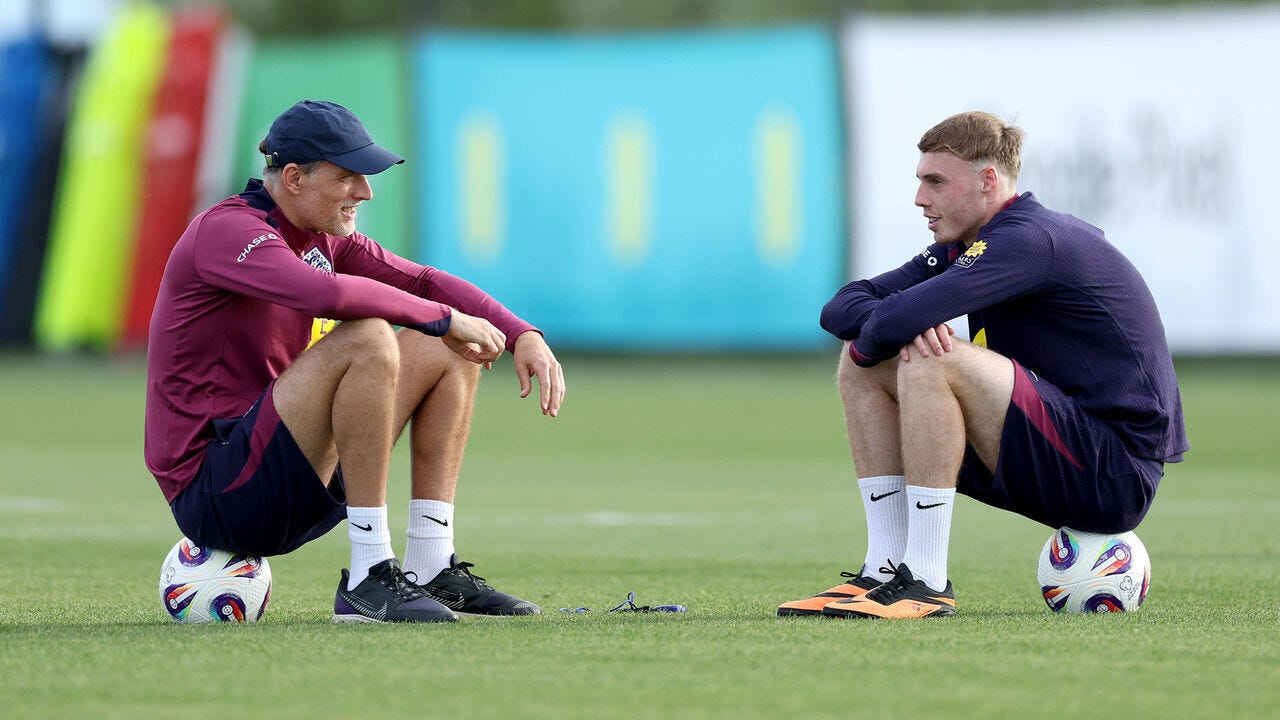
England’s first fixture since their remarkable run to a World Cup bronze medal should be the story of the day. Instead, the build up to tonight’s Nations League opener against Spain at Wembley has been dominated by something rather less celebratory: Thomas Tuchel’s growing exasperation with Cole Palmer.
The Chelsea forward withdrew from this squad on 21 September with what his club described as a small muscle injury, the fourth time he has pulled out of an England camp and his second absence since Tuchel took charge. When it was put to Tuchel that Palmer does not appear desperate to represent his country, the England manager did not offer the usual diplomatic deflection. “It’s hard to argue against what you are saying,” he said, before adding that Palmer “misses way too many camps with injuries” and that his latest withdrawal amounted to “another missed opportunity.”
A Discrepancy Tuchel Cannot Ignore
What has sharpened the debate is the contrast between Palmer’s international absences and his club workload. He has completed 90 minutes in each of Chelsea’s last four Premier League matches and played 83 minutes in the win over Fulham, numbers that sit awkwardly alongside a withdrawal from international duty on fitness grounds. Tuchel, to his credit, did not accuse Palmer of dishonesty. He accepted that the 24 year old is “playing with discomfort and pain” for his club, but was blunt about what that means for his international prospects. “He cannot compete on the highest level with discomfort and pain,” Tuchel said, adding that he judges players only on what he sees in camp with his own eyes, not on reputation built elsewhere.
That is a pointed message for a player who has featured just three times under Tuchel despite being one of the most talked about attacking talents English football has produced this decade. Palmer was left out of the World Cup squad entirely back in May, with injury problems through the 2025/26 season the stated reason, and his omission was one of the more debated calls Tuchel made all summer. Xabi Alonso, his manager at Chelsea, has been consistently warm about Palmer’s contribution this season, praising his “responsibility” and “maturity” and describing the version of Palmer currently on show as central to any hopes of a strong campaign at Stamford Bridge. The gap between that club endorsement and the national team’s patience running thin is exactly the tension driving the story.
Tuchel was also careful to frame this as more than a Palmer specific issue. He spoke about England’s camp culture in broad terms, insisting that regular attendance matters because of what it builds collectively. “This is not an international break,” he said, describing instead an environment where players “love to train with each other, be with each other,” which he called genuine togetherness. His closing line left little room for interpretation: “We will never compromise on that and we will never let this creep in that we have the feeling that players don’t want to come.”
World Champions Arrive at Wembley
None of this changes the scale of what awaits England on the pitch. Spain arrive at Wembley as reigning world champions, having beaten Argentina in an extra time thriller in July to win their second World Cup and confirm themselves as the dominant international side of this era. Luis de la Fuente’s squad still carries the spine that took them to that triumph, with Rodri marshalling midfield alongside Pedri and the same electric wide threat of Lamine Yamal and Nico Williams that tore through the tournament.
For England, this is also the first meeting between the two countries since Spain won the Euro 2024 final 2-1 in Berlin, a result that still stings for a squad now shaped very differently. Tuchel’s side head into the game on the back of that World Cup bronze medal, secured with a 6-4 win over France in Miami that handed England their best finish at the tournament since they won it outright in 1966. Declan Rice, Ezri Konsa and a two goal contribution from Bukayo Saka did the early damage in Miami, with Jude Bellingham settling it in stoppage time, and much of that spine, Bellingham, Rice, Saka, Harry Kane, returns for the visit of Spain.
This is the opening match of a demanding four game window that also takes England to Czechia and Croatia before Czechia visit Wembley in October, England’s first assignment in the new look Nations League group alongside Spain, Croatia and Czechia. Tino Livramento’s late withdrawal has left Tuchel short of natural cover at full back, with James Garner and Morgan Gibbs-White drafted in as replacements after the raft of call offs earlier in the week, but the spine of the side that thrived in North America remains largely intact.
What Happens Next
Results in these opening Nations League matches carry more weight than friendlies used to, with seeding for future tournaments now tied to performances in this competition, so tonight is not simply an exhibition rematch of a Euro final. For Palmer, the questions will not disappear even if he is not the one out on the pitch. Tuchel has made his standard clear enough: presence in camp is what earns trust, and it cannot be substituted for by club form, however impressive that form has been under Alonso this season. Whether Palmer responds by making himself undroppable next time he is fit and available is now as much a part of this story as anything that happens against Spain this evening.
For a team that spent the summer proving itself capable of competing with the very best again, an early season club versus country dispute is an unwelcome distraction, but not one that threatens to derail the bigger picture. England open a new era of Nations League football against the best team in the world, and how Tuchel’s group responds on the pitch will do far more to define this window than any post match soundbite about one absent forward.
If you enjoyed this, consider following It Was Always… Football for more on the stories shaping the game, on and off the pitch.