

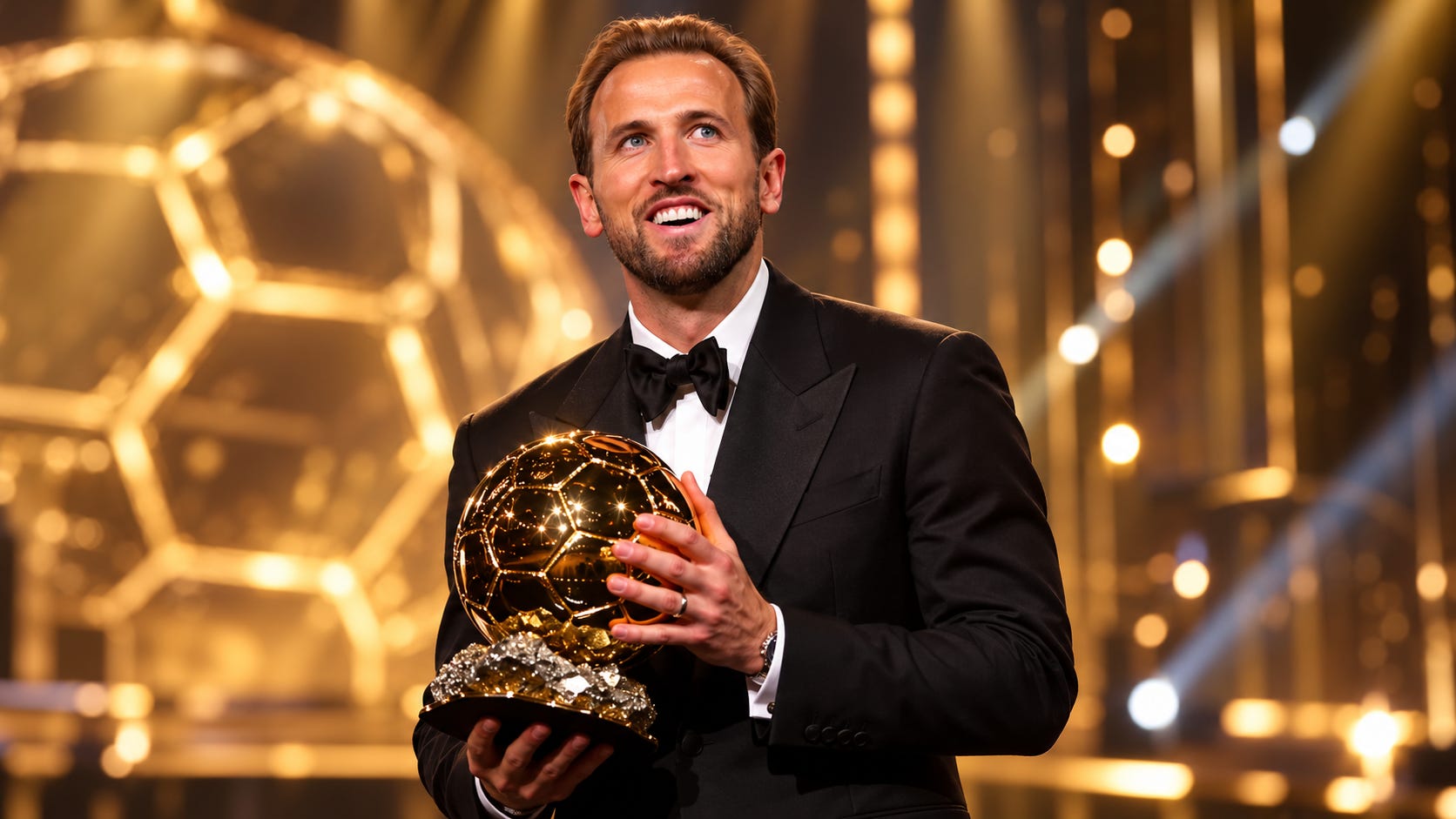
Harry Kane is the Ballon d’Or winner for 2026.
At a ceremony at the London Palladium on Monday evening, the England captain was confirmed as the finest player in the world over the past twelve months, becoming the first Englishman to win the award since Michael Owen in 2001. It closes out 25 years of waiting, and for Kane personally, it finally answers a question that has followed him for the best part of a decade: whether relentless, prolific goalscoring would ever be enough to be recognised as the outstanding footballer on the planet.
He saw off a field that included Lamine Yamal and Kylian Mbappe, the two names mentioned most often alongside his through months of speculation building towards Monday’s ceremony. Kane had gone into the night as the bookmakers’ clear favourite, and that status was confirmed when his name was read out as the overall winner, with the Gerd Muller Trophy, awarded to the competition’s leading scorer, already added to his collection earlier in the same evening.
A career finally rewarded
For most of his career, Kane’s story was told as one of brilliance without a matching return in major trophies. He scored 213 goals in 317 Premier League appearances for Tottenham Hotspur, a tally bettered only by Alan Shearer in the competition’s history, yet left the club without a single winners’ medal. He was on the losing side of a Champions League final with Spurs in 2019, then lost two European Championship finals as England’s captain, in 2021 and again in 2024, heartbreak that became a recurring and painful motif of his career. For a long time, the Ballon d’Or conversation around Kane carried a familiar shrug: brilliant, but unrewarded, and perhaps never quite destined to win the game’s biggest individual prize.
His move to Bayern Munich in the summer of 2023 changed the arithmetic completely. He has scored 156 goals in 158 appearances for the Bavarian club in all competitions since, a return that puts him among the most ruthless finishers to have worn their shirt. He has won the Bundesliga’s golden boot in each of his three seasons in Germany, lifted the league title twice, and added the DFB Pokal in 2025/26 to complete the most decorated campaign of his career so far. The goals that once felt like consolation at Spurs now arrive, season after season, alongside silverware.
A number nine’s season of numbers
This past year gave the voters little room for doubt. Kane’s scoring never let up domestically, continued into the Champions League, and followed him to the World Cup in North America over the summer, where he scored twice in a second half turnaround against DR Congo among a series of important contributions as England reached the semi finals. England’s own tournament ended in heartbreak, a defeat to Argentina followed by a third place finish against France, but Kane’s form across both matches kept him firmly inside the Ballon d’Or conversation even as Yamal helped Spain lift the trophy itself and Mbappe’s France made a deep run of their own. Individual brilliance inside a collective disappointment has been a familiar shape for Kane’s career, but this time it was enough.
The numbers behind the award are striking in their consistency rather than any single dazzling month. There was no viral moment, no single wonder goal that defined the campaign. Instead there was simply a forward who kept scoring in the Bundesliga, kept scoring in Europe, kept scoring for his country, and did it for long enough and often enough that even the sternest sceptics of a goalscorer’s claim to the award ran out of arguments.
Leaving the favourites behind
Both Yamal and Mbappe arrived in London with genuine cases of their own, and neither will have been surprised to finish behind a player enjoying arguably the most complete season of his career. Yamal, still only a teenager, continues to collect individual honours at a rate few in the game’s history can match, and was recognised again on the night with the Kopa Trophy as the outstanding young player in the men’s game. Mbappe’s season carried its own weight of expectation, built on a reputation for delivering on football’s biggest stages, but Kane’s sheer volume of goals across club, continental and international football proved difficult to argue against once the voting closed.
There is a tidy piece of football history in the result too. Kane becomes the first player based in the Bundesliga to win the Ballon d’Or since Matthias Sammer in 1996, and only the second former Tottenham player to do so, following Luka Modric’s win in 2018 after his move to Real Madrid. For Bayern Munich, it is their first winner since Karl-Heinz Rummenigge collected the award in successive years in 1980 and 1981, a gap that stretched across nearly half a century before Kane’s arrival in Bavaria finally closed it.
What the award recognises, more than anything, is persistence. Kane did not reinvent himself to win it. He simply kept doing what he has always done, in a shirt that finally gave those goals a stage worthy of them, surrounded by a Bayern side capable of turning his finishing into trophies rather than mere statistics. The three major final defeats that once threatened to define his career now read as a prelude rather than a conclusion, and English football has its first Ballon d’Or winner in a generation to show for it.
Monday night in London will be remembered as the moment a career built on remarkable consistency finally received the individual recognition that had so narrowly and so repeatedly escaped it. For a player who has spent a decade being admired for his numbers while being quietly written off as a nearly man, there is something fitting about winning football’s greatest individual prize not with one unforgettable night, but with an entire season of them.
If you enjoyed this, consider subscribing to It Was Always… Football for more on the stories shaping the game, old and new.