

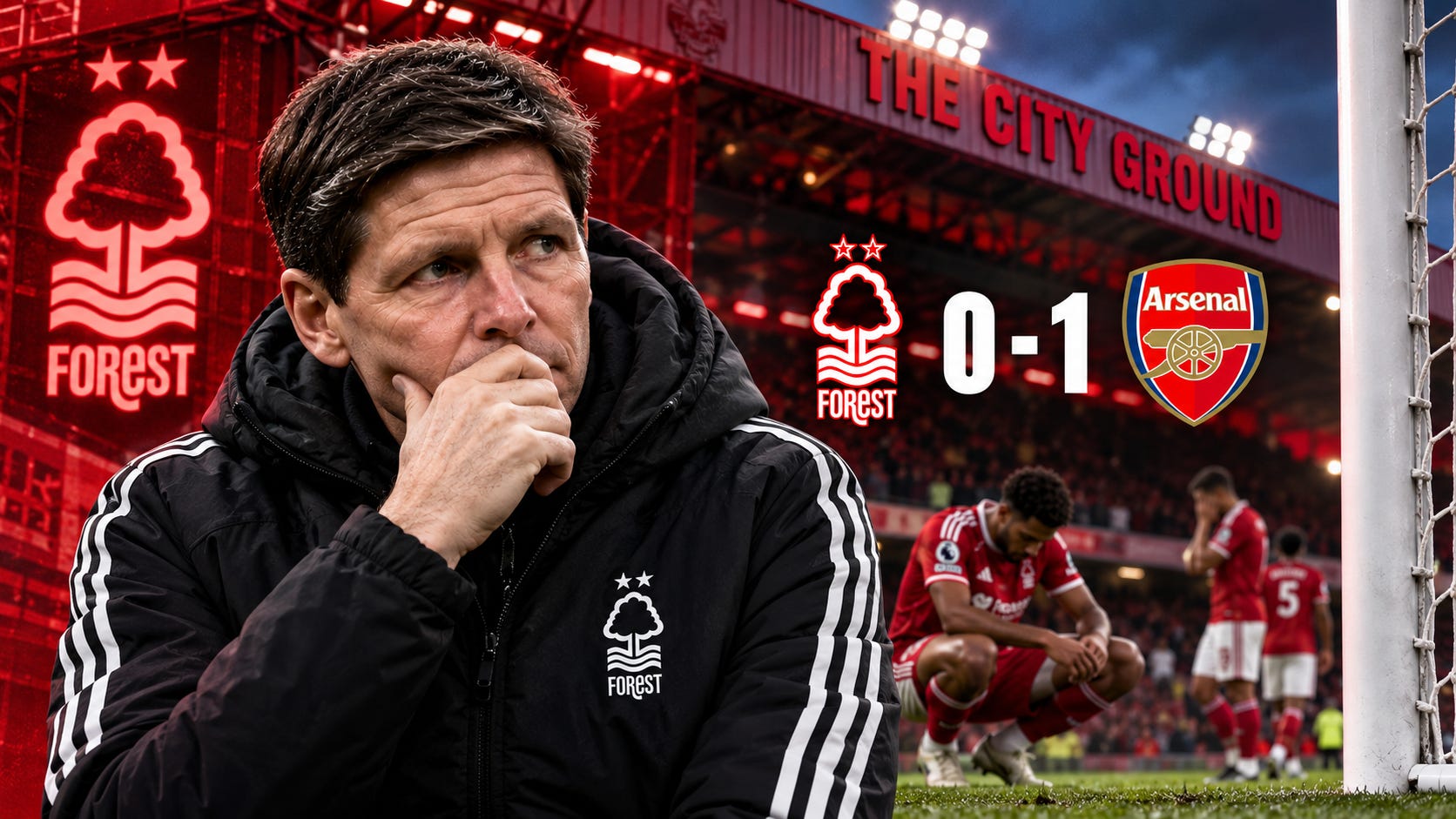
Nottingham Forest have still not scored a home Premier League goal this season, and after Sunday’s 1-0 defeat to Arsenal at the City Ground, they have slipped into the bottom three for the first time this campaign. It is a genuinely strange situation for Oliver Glasner’s side to be in, because by most other measures they were the better team for long stretches against a side chasing the leaders.
Noni Madueke settled it in the 80th minute, cutting in from the left and shooting from a tight angle, the ball deflecting off Jair Cunha and wrong footing goalkeeper Matz Sels. It was the only shot Arsenal had on target all afternoon. Mikel Arteta’s side had 75% of the possession and barely threatened for long spells, yet they still found a way to leave with all three points, moving to second in the table, three behind leaders Manchester City.
For Forest, it continues a pattern that is becoming genuinely hard to explain. They have now failed to score in every Premier League home fixture this season, taking not a single point from those games, despite having some of the best underlying attacking numbers in the division. Before kick off they were averaging 17.7 shots and 1.72 expected goals a game, both among the division’s higher totals, yet converting barely 5% of their chances, by far the worst return in the Premier League. Liam Delap, Forest’s record signing, has managed only two shots on target from fourteen attempts since arriving.
Sunday did little to change that picture, even though the performance itself had real promise in it. Gabriel’s header for Arsenal was hacked off the line by Ousmane Diomande in the first half, and Kai Havertz headed over from a Declan Rice free kick, but for long periods it was Forest creating the better openings. Chris Wood, introduced from the bench, saw a late effort blocked by Rice in the 89th minute, and Murillo curled narrowly wide in stoppage time as Forest searched for an equaliser that never came. Ezri Konsa’s last ditch intervention denied Delap one more sight of goal before the final whistle.
Glasner, usually candid in defeat, sounded almost bewildered afterwards. “It is very tough not to get anything from that today,” he said. “The effort and everything was amazing, it is just the result we can’t be pleased with.” He pointed to the bigger picture rather than searching for excuses, adding that it was “in our responsibility to not drop our heads and build on the performance,” even with a third straight defeat on the board and zero points from home league games.
Arteta, by contrast, was simply relieved to have found a way to win a fixture his side would not always have managed in recent years. “We’ve done something that we didn’t do in the last two seasons,” he said of winning at the City Ground, praising Forest as “extremely well coached, so well organised in the game” and stressing that Arsenal “have to be so patient without losing the capacity to threaten.” He singled out his match winner too, saying Madueke “is becoming now decisive in matches, which is what we expect from a player like him.” Madueke himself kept it simple: “Thank god it went in.”
A Problem That Numbers Alone Cannot Explain
What makes Forest’s situation so unusual is that nobody is pointing to a lack of effort or quality in the final third as the explanation. The shots are there. The expected goals are there. What is missing is the finishing, and no amount of praise for the underlying performance changes a table that now has Forest in 18th place with five points from seven games, level with relegation rivals but behind them on goal difference. Sunderland and Tottenham occupy the other two bottom three spots, both also still searching for consistency of their own.
There is a context worth remembering here. Forest have won only once at the City Ground in their last fourteen Premier League matches, a run that predates Glasner’s arrival in the summer after his Conference League triumph with Crystal Palace. The problem he inherited has not gone away under him, even if the performances suggest it should be closer to resolving itself than the results indicate.
Glasner has not been shy about adding to the squad since taking over. Diomande arrived from Sporting in the summer to strengthen the back line, and Delap came in as Forest’s record signing to lead the line. On paper there is a side here with enough quality to be nowhere near the bottom three, and Dan Ndoye remains the club’s leading scorer this season despite the home drought, having found the net on their travels. The picture that emerges is not of a squad short of attacking talent, but of one that keeps finding new ways to leave its best work in the final third unrewarded.
What Happens Next
There is a little breathing space before the fixtures get harder again. Forest travel to Ipswich Town next weekend and then to Brentford at the end of the month, two matches away from the pressure of the City Ground where they might realistically expect to pick up the points their home form has denied them. After that comes a daunting stretch, with Manchester City visiting on 7 November and Chelsea arriving on 28 November, both tests that will tell us a great deal more about whether this Forest side are simply going through an unlucky patch or facing something more serious.
For now, the numbers suggest a side that is far from the bottom three on merit, even if the table says otherwise. Whether that gap closes before it is too late may define Glasner’s first season in charge.
If you have enjoyed this piece, consider subscribing to It Was Always… Football for more stories like it, covering the moments and the history that make this game worth following.