

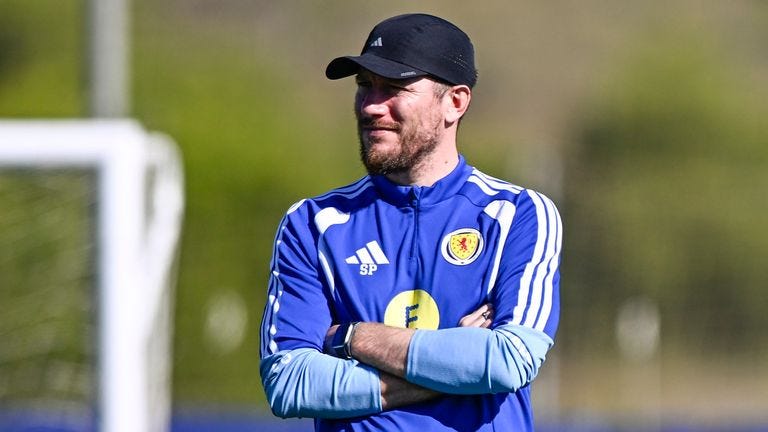
Steve Clarke’s long spell in charge of Scotland ended in the summer, brought down by a group stage exit at the World Cup that few north of the border saw coming after so much progress under him. The Scottish FA moved quickly, and on 16 August they confirmed Sébastien Pocognoli as his successor on an initial two year deal. This week the 39 year old Belgian named his first squad, and it tells you plenty about how he intends to go about the job.
Pocognoli has picked five uncapped players for the upcoming Nations League fixtures, while also welcoming Oli McBurnie back into the fold for the first time in five years. It is a squad built around Scotland’s established core, but with clear signals that the new head coach is prepared to look beyond the names who carried the country to a first World Cup finals in decades.
The coach who ended a 90 year wait at Union Saint-Gilloise
Pocognoli arrives with a reputation built on one of European football’s more remarkable recent stories. He took charge of Union Saint-Gilloise and led them to the Belgian Pro League title, ending a wait of 90 years for the Brussels club, before guiding them into the Champions League group stage for the first time in their history. He also won the Belgian Super Cup and was named Belgian Coach of the Year for his work, form that earned him the AS Monaco job in 2025 and, now, the chance to manage a national team.
As a player, Pocognoli was a left back who won 13 caps for Belgium and had a well travelled career, taking in Genk, AZ Alkmaar, where he won the Eredivisie under Louis van Gaal, Standard Liège, Hannover 96, West Bromwich Albion, Brighton and Hove Albion and, finally, Union Saint-Gilloise before retiring in 2021. That mix of Belgian, Dutch, German and British football experience is part of what convinced the Scottish FA he was the right fit.
“It’s an honour to be asked to become the Head Coach of the Scotland National Team,” Pocognoli said. “Scotland’s supporters are famous for their passion.” Scottish FA chief executive Ian Maxwell described him as the standout candidate from a thorough process, while chief football officer Craig Mulholland called him one of Europe’s brightest and most sought after coaches. Given the calibre of names Union Saint-Gilloise’s success generated interest from across the continent, that is not idle praise.
A squad built on balance
Pocognoli’s first Scotland squad brings in five uncapped players. Robbie Ure, a Rangers academy product who scored 20 goals in 20 matches for Sirius in Sweden before earning a summer move to Sevilla, gets his chance up front. Stephen Welsh, who impressed on loan at Motherwell from Celtic last season and has since joined Swansea City, and Colby Donovan, Celtic’s right back and a regular for them this season, both come in at the back. Luis Binks, now captain of Danish side Brøndby, and Luke Graham of Stoke City complete the group of newcomers.
There is a warmer story too in the recall of Oli McBurnie, uncapped at senior level since 2021 but rewarded now for form at Hull City. Former Scotland striker James McFadden was among those to praise the decision, pointing out that McBurnie has gone away, worked on his game and earned his opportunity back.
Pocognoli will be without some significant figures. Scott McTominay is recovering from minor heart surgery, Lawrence Shankland is nursing a hamstring problem and Che Adams is also injured, while a dozen players who were part of Scotland’s World Cup squad do not feature this time around. “We have plenty of experience in the team, there are some new faces and young lads, and I think we have a good mix,” Pocognoli said of his selection, stressing that continuity with what has made Scotland competitive matters just as much as fresh blood.
A Nations League that carries real stakes
Scotland’s reward for a playoff defeat to Greece was relegation from Nations League A, and Pocognoli’s first assignment is a four game push to get straight back up. Scotland travel to Slovenia on 26 September before hosting Switzerland at Hampden three days later, then face North Macedonia away on 3 October and Slovenia again at home on 6 October. Results across those four matches will determine promotion or a second successive season in the tier below the continent’s elite, and they will also give the clearest early picture yet of how Pocognoli wants his Scotland side to play.
There is no shortage of pressure that comes with replacing a manager who took the country to a World Cup, and Pocognoli knows a difficult start would invite scrutiny fast. But there is genuine intrigue here too. A coach who broke a 90 year title drought at Union Saint-Gilloise and pushed them into Europe’s top competition is not short of credentials, and the willingness to blend McTominay’s midfield generation with a striker plucked from Sweden’s top flight suggests a manager prepared to trust his own judgement rather than simply picking the safe, established names.
Scotland have not always found it easy to move on cleanly from a popular, successful manager. Pocognoli’s Hampden era starts for real in Slovenia on Saturday, and it will not take long to find out whether this new mix of youth and experience can keep the momentum of recent years going.
If you enjoy this kind of football coverage, consider subscribing to It Was Always… Football for more stories like this one.