

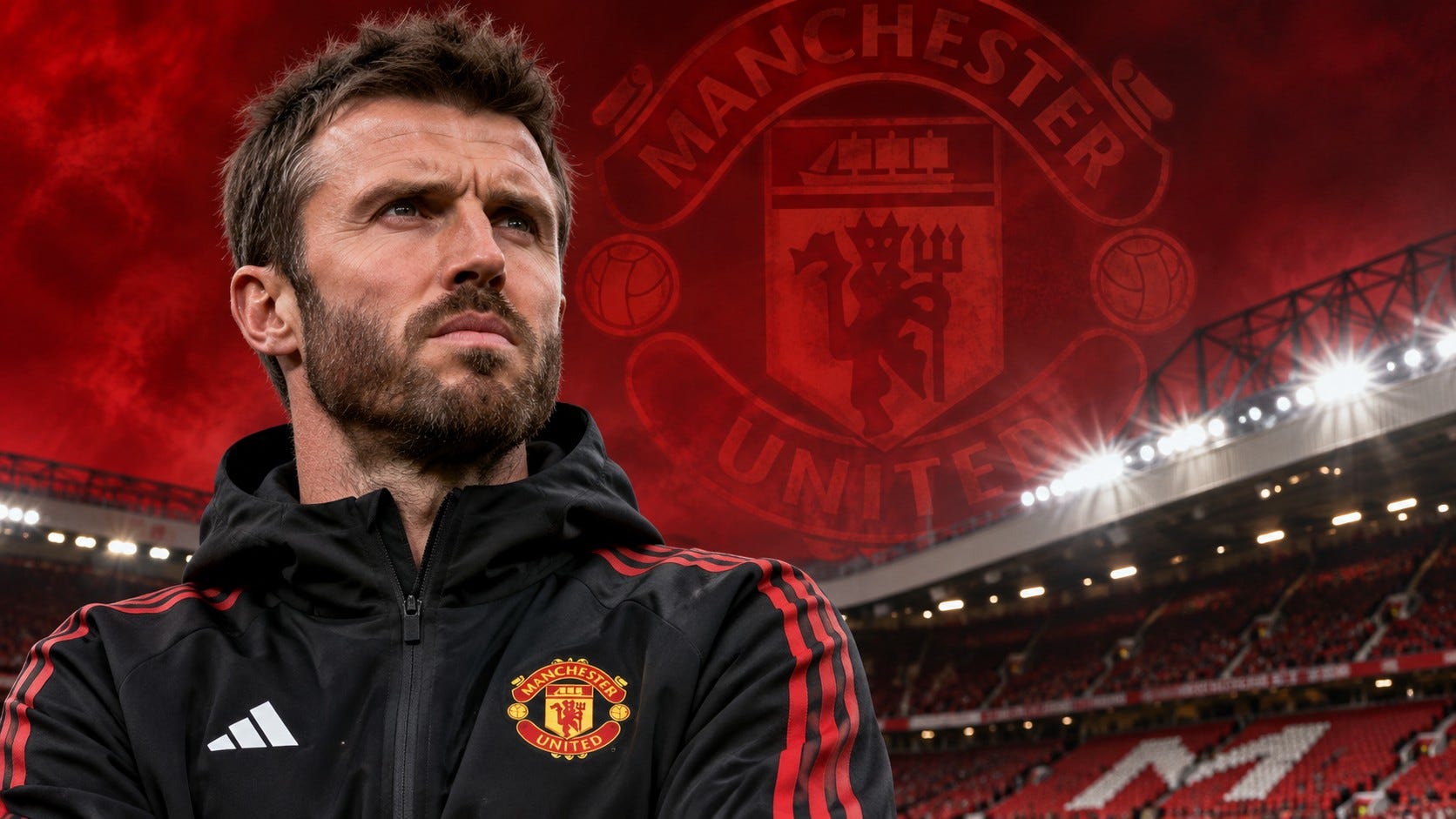
Michael Carrick is still in charge at Old Trafford this morning. Nobody at Manchester United has said otherwise, and nothing has been confirmed. But in the hours after Sunday's extraordinary 4-4 draw with Aston Villa, a game in which United trailed twice by two goals, clawed level, then fell behind again before Patrick Dorgu's stoppage time header finally rescued a point, the noise around Carrick's position has grown louder than at any point since he took permanent charge of the club.
The Athletic's Laurie Whitwell reported this week that United intend to use the international break to carry out a formal reassessment of Carrick's position, a process he described as "a reassessment is in the works." Whitwell was careful to add that there is no immediate urgency behind it. "I don't think Michael Carrick is going to lose his job as we speak right now," he said, which is some way short of the dramatic sackings sometimes reported elsewhere. Sky Sports and other outlets have since relayed similar reporting that United are braced to part with Carrick at some point during the break, with his side not expected to be in the dugout for the trip to Liverpool on 22 November, their first match back.
A deadline that has been building for months
This is not a new story so much as an old one finally arriving at its conclusion. United's hierarchy, chief executive Omar Berrada and director of football Jason Wilcox among them, have been monitoring Carrick's position since at least late October, when senior figures convened at the Carrington training ground following a heavy home defeat to Bournemouth. TEAMtalk's Graeme Bailey has reported for weeks that club sources regard the international break as the point at which Carrick's time in interim and then permanent charge was always likely to be settled one way or the other, with earlier fixtures against Roma and Villa treated as a stay of execution rather than a reprieve.
What has changed is the mood around that eventual decision. United's results since have been chaotic rather than catastrophic: a thrilling Champions League comeback win over Roma from two goals down, followed by Sunday's eight goal draw with Villa, in which United trailed 2-0, then 4-2, before Joshua Zirkzee and Dorgu dragged them level in the closing minutes. Carrick himself said afterwards that his side had "beaten themselves" with individual errors, a verdict that captures the strange position United find themselves in: a team capable of staging remarkable recoveries, yet still bottom three on goal difference alone, a single point off safety.
The bookmakers already have an answer
Where the picture has genuinely moved on from earlier reporting is in who might replace Carrick, should United finally pull the trigger. According to odds from MGMBET relayed this week, Mauricio Pochettino has emerged as the clear new favourite at 5/2, ahead of Eddie Howe at 3/1, with Antonio Conte, Julian Nagelsmann and Fabian Hurzeler also mentioned as possibilities. Pochettino, currently in charge of the United States national team, recently signed a new contract taking him through to 2030, a deal that would complicate any approach, though reports in The Standard, picked up by ESPN among others, suggest he would be open to a return to the Premier League if the right opportunity arose. Howe and Nagelsmann, both currently out of club jobs, remain the more straightforward options on paper, and have been the names most consistently linked with Old Trafford since the summer.
None of this amounts to an approach, let alone an agreement. Nobody at United has made contact with any of the names mentioned, as far as any reputable outlet has reported, and the shift in the betting markets reflects public perception and reporting as much as it reflects anything United's board has actually decided. The distinction matters. United's own position, relayed through Whitwell and others, remains that an assessment will take place, not that a conclusion has already been reached.
What Carrick still has to work with
The case for keeping faith with Carrick is not nothing. He steadied the club dramatically in the second half of last season, guiding United to a top four finish and Champions League qualification after taking over mid campaign, and he has shown again this autumn that his sides do not stop competing even when games appear lost. The problem, as Sunday demonstrated all too clearly, is that United keep needing to come from behind in the first place. Twice falling two goals behind at Old Trafford against a mid table Aston Villa side, having already done something similar against Roma, points to a defensive fragility that no amount of late drama can properly disguise, and it is that pattern, more than any single result, which appears to be driving the club's thinking.
The international break gives United's hierarchy nearly a fortnight without a match to make up its mind, and the trip to Anfield on 22 November now looks like the moment everything becomes clear one way or another. A United side that travels to Liverpool with Carrick still in charge will have answered one question. A change of any kind before then would answer it rather more dramatically. Either way, the club that spent much of October insisting results would decide Carrick's future now finds itself needing a response long before its next ball is kicked.
For now, nothing has changed at Old Trafford except the temperature of the speculation around it. Carrick remains the manager, United remain in the bottom three, and the only certainty is that the next fortnight will tell us a great deal more than the last one did.
If you enjoyed this, consider subscribing to It Was Always... Football for more on the stories shaping the Premier League and beyond.