

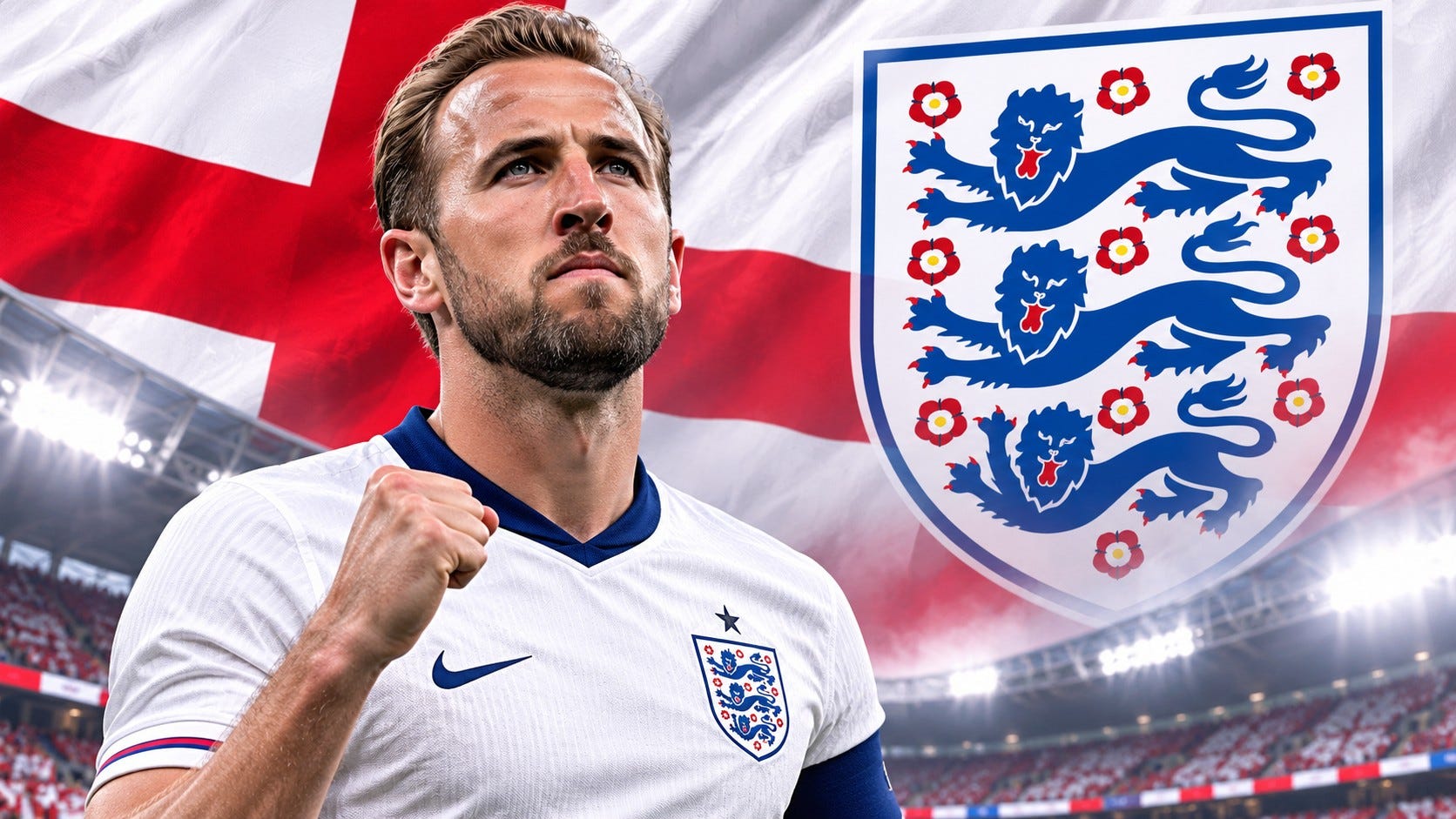
Harry Kane has spent the last few years quietly rewriting England's record books, but even by his standards, November has been a remarkable month. On Thursday night at Wembley, in a Nations League tie against Croatia that England won 2-1, Kane won his 126th cap for his country. In doing so, he became the most capped player in the history of the England men's team, moving past a mark that had stood since 1990.
The goal itself, a penalty converted after Ivan Smolcic had pulled down Jarell Quansah at a corner, was Kane's 92nd for England, another record he already held. But it was the appearance that mattered most. Before kick off, Wembley paused for a presentation to mark the occasion, with the Prince of Wales among those in attendance and the man whose record Kane had just taken, Peter Shilton, there in person to hand over the recognition himself. Kane called it an emotional night. "It was incredible," he said afterwards. "Everything was amazing."
The night a 36 year old record finally fell
Records like this one tend to last a long time precisely because of what it takes to set them. Shilton made his England debut in 1970 and did not win his final cap until 1990, a 20 year international career that took in three World Cups and 125 appearances between the posts. He had broken Bobby Moore's long standing appearance record back in 1989, and by the time he retired from international football the following year, his own total looked close to untouchable. Goalkeepers who play into their late thirties are rare. Goalkeepers who do it at the very top of the game, for two decades, without ever being sent off at international level, are rarer still.
Kane's route to the same number has looked very different, built on a different kind of durability. Strikers are supposed to be the players managers rest, rotate and protect from burnout, yet Kane has barely missed an England squad in a decade, scoring goals for fun along the way and somehow still finding new gears in his early thirties at Bayern Munich. He had already matched Shilton's 125 caps with a brace against Czechia back in October, so the record itself was not a surprise by the time Thursday arrived. What made it feel significant was the context around it, and the sense that English football was watching one of its most decorated careers add still another milestone to an already extraordinary list.
Why Peter Shilton's number mattered so much
It is worth pausing on just how significant Shilton's total was considered for so long. For a generation of England supporters, 125 caps felt like one of those untouchable numbers, up there with Bobby Charlton's goal tally, the kind of record mentioned in the same breath as players who belonged to a different, almost mythical era of the national team. Shilton won it all the hard way too, across an era when England did not always qualify for major tournaments and when a goalkeeper's place was never guaranteed from one squad to the next. He played in Spain in 1982, Mexico in 1986 and Italy in 1990, the last of those ending in the heartbreak of a penalty shootout defeat to West Germany in the semi final, with Shilton beaten by Andreas Brehme's effort before the shootout even began.
That history is exactly why this matters to a publication built on appreciating the game's past as much as its present. Kane is not simply breaking a number on a spreadsheet. He is overtaking a genuine giant of English football, a player who kept goal through three different decades and three different England eras, and whose record had quietly outlasted every single player who has worn the Three Lions shirt since. For it to fall now, to a current England captain still playing at the highest level rather than a name from the archives, gives the achievement an extra layer that records broken by retired players rarely carry.
A captain who is somehow still getting better
What makes Kane's timing so striking is that the caps record did not even arrive in isolation. Barely three weeks earlier, he was named the winner of the 2026 Ballon d'Or, becoming the first Englishman to collect the award since Michael Owen back in 2001, and only the latest in a short list that also includes Stanley Matthews, Bobby Charlton and Kevin Keegan. He was credited with 73 goals for club and country across the season that earned it, numbers that still look faintly ridiculous written down. To then go past Shilton's appearance record within weeks of that ceremony is the kind of coincidence that writes its own headline, two career defining achievements landing almost on top of each other in the same extraordinary autumn.
None of it has come without scrutiny on the night itself. England's performance against Croatia was far from their best, a little flat and short of ideas for long periods after Morgan Rogers had given them an early lead, before Petar Sucic equalised and Kane's penalty settled it. Pundits were quick to point out how different this version of England looked compared with the one that beat the same opponents 7-0 just a month earlier. None of that will matter much in years to come. What will be remembered is the number, and the player who now holds it.
England's reward for winning the group would be a seeded route into next March's Nations League quarter finals, and that is now in their own hands heading into Sunday's trip to Madrid, where they face World Cup holders Spain in a match that decides top spot in the group. Kane will be there, as he always is, closing in on yet another milestone most players would consider the achievement of a lifetime, and still finding ways to make it look like just another week's work.
If stories like this are the sort of thing you come back for, the best way to make sure you never miss one is to subscribe to It Was Always... Football.