

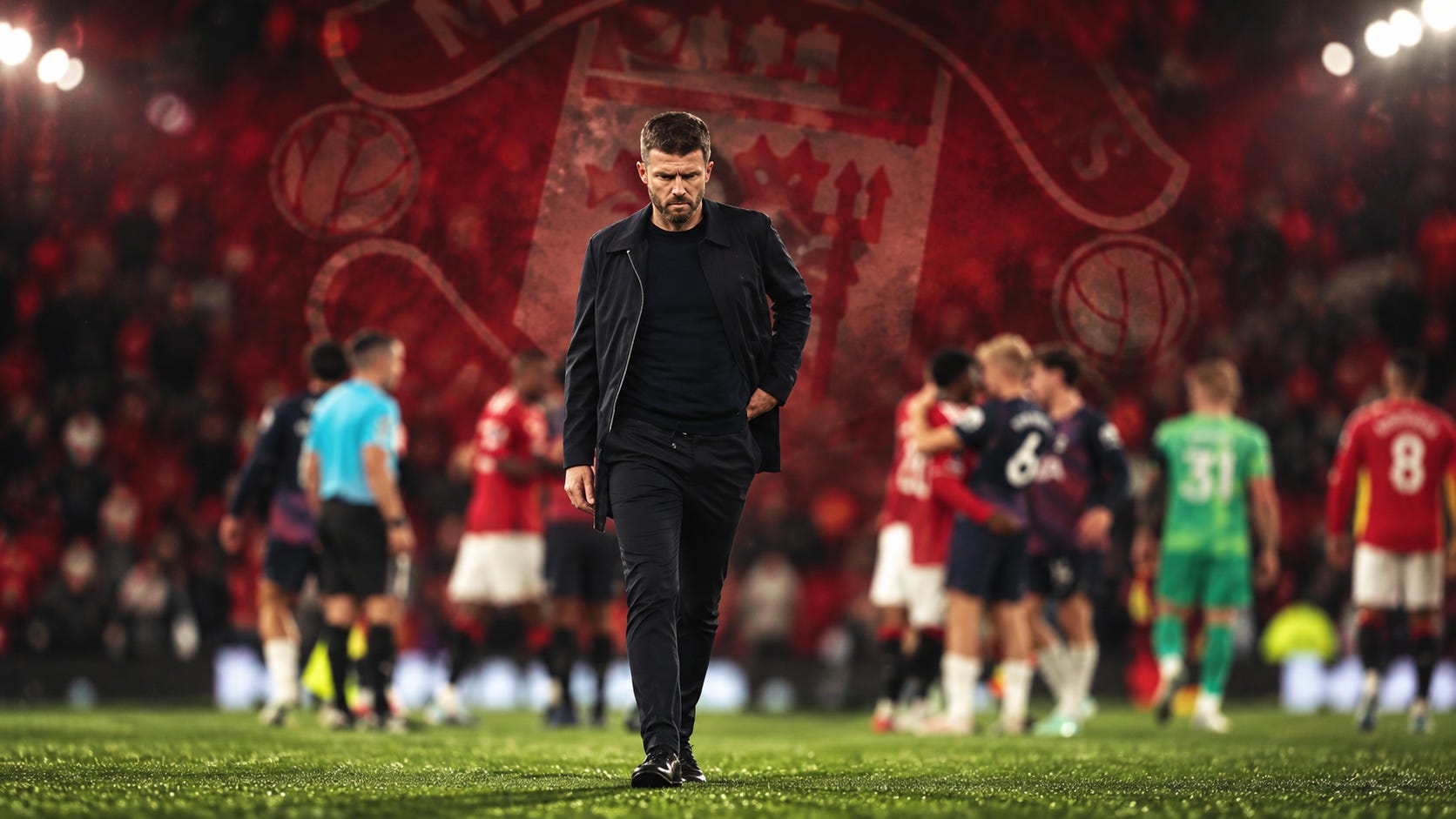
There was no disguising it in Michael Carrick’s face at full time on Saturday. Manchester United had just been pegged back by ten man Tottenham deep into stoppage time, the boos were rolling around Old Trafford for the second time in the game, and the manager who had arrived with such goodwill a year ago was being asked, once again, to explain why his side cannot see out a match.
Carrick did not try to talk his way around it. “It hurts, you know, it hurts a lot,” he said afterwards, when asked about the reaction from the home end. “It’s coming from a good place, really, and so I understand it.” It was an honest answer from a manager who knows exactly how precarious life at Old Trafford can be, and it summed up where United find themselves six games into the season: short of points, short of answers, and increasingly short of patience from their own supporters.
How United Let Two Points Slip Again
Bryan Mbeumo had given United the lead, and for long periods it looked enough. Tottenham were reduced to ten men when Rodrigo Bentancur was sent off, and a home crowd that had already turned on its own team at the interval sensed the platform for a routine win. Instead, Dominic Solanke headed home a 92nd minute equaliser after United failed to clear their lines, and a result that should have eased the pressure on Carrick only added to it.
It was the second time this season United have failed to beat a side down to ten men, following last month’s defeat to Manchester City, and the second time they have conceded a late goal to drop points they looked to have won. Carrick was blunt about the pattern afterwards, saying his side need to “see out games” better, whether they hold a numerical advantage or not. Bryan Mbeumo, for his part, admitted the first half performance “wasn’t us,” a half in which Tottenham, even before their red card, had the better of the chances.
The Numbers Behind the Alarm
Strip away the emotion of the boos and the raw figures are just as damning. United have taken only six points from their opening six Premier League matches, their lowest return at this stage of a season in four decades. They sit 12th in the table, closer to the relegation zone than to the European places, and have won only one of their last six league outings. In all competitions they are winless in four, a run that also contains their League Cup exit at the hands of Brighton last month.
This is not simply a story about one disappointing afternoon. It is the continuation of a pattern that has followed Carrick since the optimism of last season’s interim spell, when he arrived to replace Ruben Amorim and oversaw a run of results good enough to earn him the job on a permanent basis. The goodwill built up then is not gone, but it is being tested by six weeks in which, in Carrick’s own words, United “haven’t had a great week, or two or three weeks.”
Neville’s Verdict and the Pressure Building on Carrick
Gary Neville did not hold back on Sky Sports. He described the mood inside Old Trafford as “worrying,” pointing out that home supporters had booed United after 22 minutes, again at half time, and once more at the final whistle. “What we’re seeing at the moment is a team that looks like they’re curling up in a ball,” he said, before questioning the balance of a midfield pairing of Youri Tielemans and Kobbie Mainoo that he felt offered Carrick too little control against a Tottenham side missing a man for most of the second half.
Crucially, Neville was careful to separate the crowd’s frustration from any direct campaign against the manager himself. “I don’t think the boos are against Michael Carrick for one minute,” he said, adding that he believed supporters would stay with the broader project at the club. But he was equally clear that the margin for error is shrinking fast, warning of “a worrying few weeks” if United cannot turn their form around soon, and noting that players who are “not quite right there from a mental and physical perspective” are being exposed on a weekly basis.
That is the uncomfortable truth Carrick now has to manage. There is no suggestion from inside the club that his position is in genuine danger, and Neville’s reading, that this is a collective malaise rather than a managerial crisis, will offer some reassurance. Even so, seventh permanent manager status since Sir Alex Ferguson’s retirement in 2013 is not a statistic anyone at Old Trafford wants repeated, and another dip in results will inevitably sharpen the questions being asked of the man in the dugout.
What Comes Next for Carrick’s Side
There is little time to dwell on Saturday’s frustration. United travel to face Atletico Madrid in the Champions League in midweek, before a Premier League trip to Leeds, a home Champions League tie with Como, and league fixtures against Bournemouth and Chelsea before the end of the month. None of those represent an easy route back to form, and a difficult run of results through that sequence would turn Neville’s warning about a worrying few weeks into something considerably more serious.
For now, Carrick’s honesty in the face of boos from his own supporters feels like exactly the response the moment demanded. Whether United’s performances on the pitch can match that honesty, starting in Spain this week, is the question that will define whether this season becomes a story of recovery or of a club returning to the kind of upheaval it has spent the last year trying to escape.
If you enjoy getting under the skin of stories like this one, subscribe to It Was Always… Football for more on the clubs, characters and controversies shaping the modern game.