

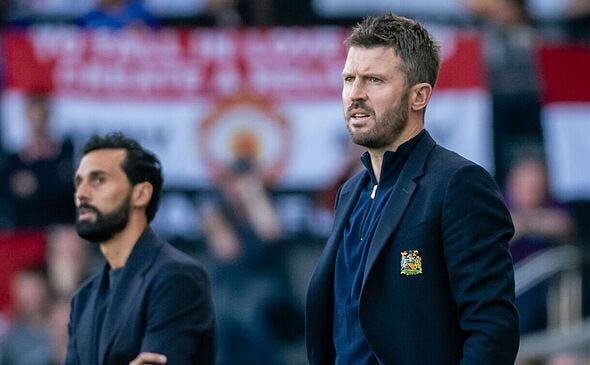
Manchester United have decided against sacking Michael Carrick, at least for now, despite a start to the season that has left the club sitting 12th in the Premier League with a single win from their opening five matches. According to Fabrizio Romano, INEOS have held no contact with prospective replacements and remain committed to giving their head coach time to turn things around, even as speculation about his position has grown louder with every passing week.
The context makes the decision to stand by him a striking one. United have lost to Hull City and Manchester City, drawn with Everton and Fulham, and beaten only newly promoted Ipswich Town in the league so far this season. Worse than any of those results was the manner of their exit from the Carabao Cup at home to Brighton on 16 September, surrendering a 2-0 lead to lose 3-2 in what was reported as United’s first home defeat from two goals up in fifty years. Carrick accepted responsibility afterwards, but the collapse hardened doubts about a side that was supposed to be building on a promising end to last season.
Why United are not pulling the trigger
Romano’s reporting points to two separate reasons for the club’s patience, one financial and one footballing. The financial calculation is straightforward. Sacking Carrick now would reportedly cost Manchester United around £8.8m in compensation, a sum the club is reluctant to pay out again so soon after the upheaval of recent seasons. Journalist Pete O’Rourke put it plainly: United “can’t really afford more upheaval after numerous managerial changes over the seasons,” a reference to a period that has already seen Erik ten Hag and Ruben Amorim both dismissed before their contracts had years left to run.
The footballing case for patience is that Carrick inherited a squad still being reshaped and has not yet had a settled group to work with. Carlos Baleba’s £70m arrival from Brighton in August was meant to be the final piece of a rebuilt midfield, but Romano says the club believes that rebuilt unit simply needs time to develop cohesion together. “With some time, balance is arriving,” was how he summarised United’s internal thinking, while also stressing that patience is not unconditional. “Results remain essential to guarantee the coach’s continuity,” he added, a reminder that goodwill has a shelf life.
A different kind of crisis to Ten Hag and Amorim
What appears to be protecting Carrick more than anything else is the dressing room itself. Romano has been clear that the picture inside Old Trafford now is very different to the final months of both his predecessors, saying “United’s players support Carrick and his ideas, and the vast majority of them back him.” Neither Ten Hag nor Amorim, by contrast, enjoyed anything like that level of backing by the time their positions became untenable.
That distinction matters at a club that has learned, expensively, what it looks like when a manager loses the squad. Carrick’s connection to Manchester United, first as a decorated midfielder under Sir Alex Ferguson and then through a popular interim spell that yielded twelve wins from seventeen league games before his permanent appointment in May, still counts for something inside the building. It buys him a version of goodwill that neither Ten Hag nor Amorim ever established, even if it cannot substitute for results indefinitely.
Eddie Howe’s reluctance complicates any change
Part of the reason United have the luxury of patience is that the obvious alternative is not obviously available. Bookmakers have installed Eddie Howe as favourite to take over should Carrick be dismissed, with Antonio Conte and Julian Nagelsmann also mentioned as possibilities. But according to sources close to Howe cited by the Telegraph, the 48 year old currently has no interest in returning to club management at all. “He is not thinking about football at all, he is not thinking about another job and currently has no plans to return to management,” one source said, adding that Howe would only be tempted back by something “really special.”
That reluctance removes some of the urgency from any hypothetical change, since replacing Carrick in a hurry with an underwhelming option would carry its own risk. For now, United appear content to let the situation play out rather than force a decision they are not ready, or able, to make.
The fixtures that will decide it
United’s next run of matches looks likely to settle the argument one way or another. A home game against Tottenham Hotspur on 10 October is followed swiftly by a trip to Atletico Madrid in Europe on 13 October, then away days at Leeds United on 18 October and Como three days later. It is exactly the kind of sequence, against a mixture of direct rivals and continental opposition, that tends to clarify whether a struggling team’s problems are temporary teething issues or something more serious.
Carrick himself has given no indication that he sees his job as under genuine threat, focusing instead on the process of bedding in a squad reshaped around Baleba and the rest of this summer’s arrivals. Whether that patience from the Old Trafford boardroom survives another poor run is impossible to say with certainty, but for now, the numbers, the dressing room and the absence of an obvious alternative have combined to buy Michael Carrick more time than many outside the club expected.
If you want the stories behind the headlines from across English and Scottish football, subscribe to It Was Always… Football for more.