

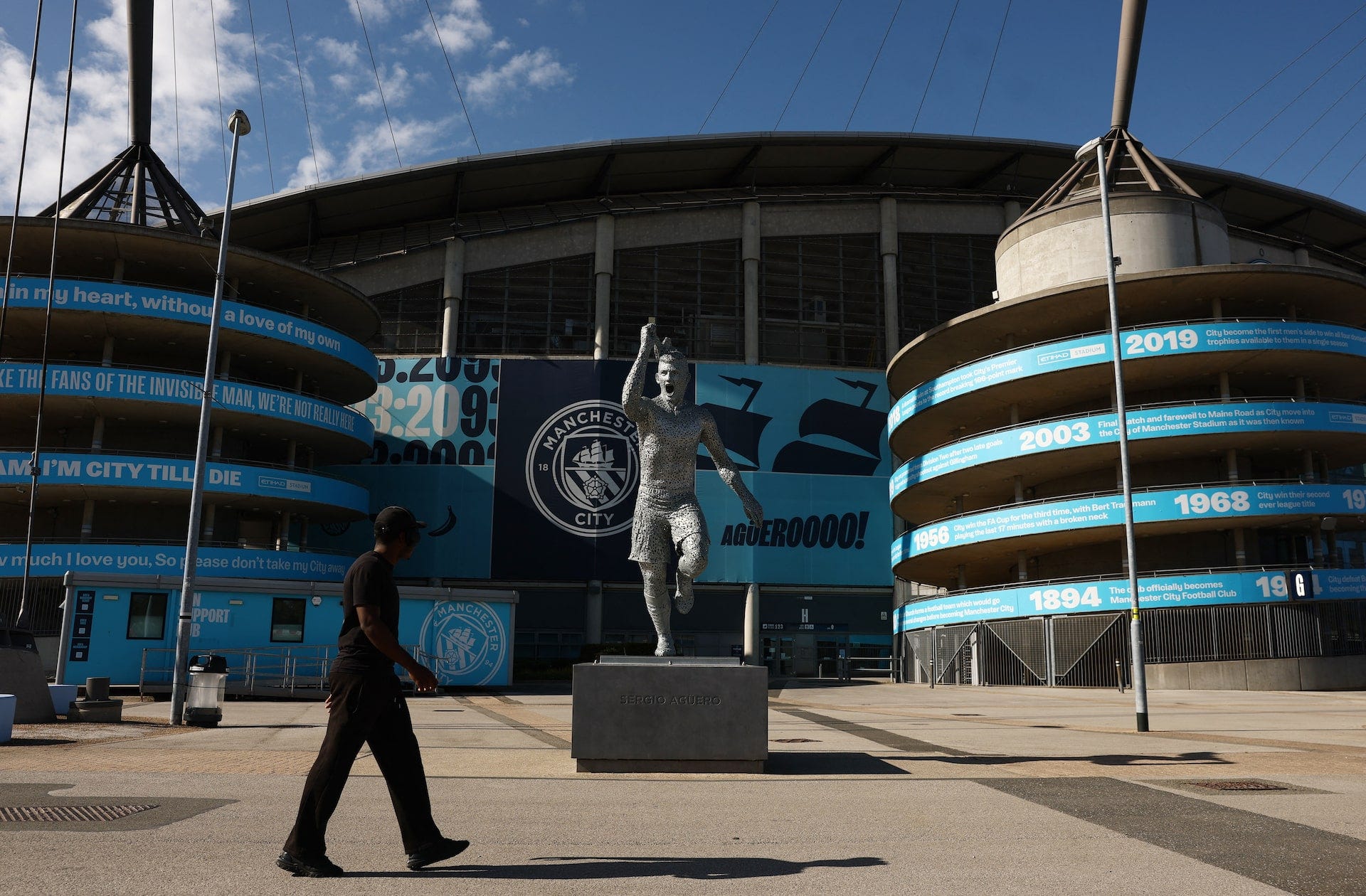
Manchester City have made clear they have no intention of accepting last week’s guilty verdict quietly. Speaking at a European Football Clubs board meeting in Copenhagen on Monday, chief executive Ferran Soriano told fellow club executives that the dispute with the Premier League is far from over, warning it could drag on for years to come.
“It has taken eight years to get here, and it’s going to take a lot more time,” Soriano said, according to reporting from the meeting. He is said to have declined to take further questions from reporters as he left, but the message was unmistakable. Manchester City intend to fight this to the end, whatever that end eventually looks like.
It is worth remembering just how long this saga has already run. The Premier League’s investigation into City’s finances stretches back to 2018, when the initial allegations first emerged from leaked documents. The formal charges were not brought until February 2023, and the independent hearing that followed took months to complete. Soriano’s reference to eight years places the origin of this fight well before most of City’s current first team squad had even arrived at the club.
Why the verdict matters
Last Friday, an independent commission found Manchester City guilty on 114 of the 115 charges brought against them by the Premier League. The breaches, which the commission ruled span back to 2009, relate to four broad categories: failing to provide accurate financial information across nine separate seasons, failing to fully disclose details of player remuneration between 2010 and 2016, failing to detail manager pay (specifically covering Roberto Mancini’s time in charge between 2009 and 2013), and failing to cooperate properly with the Premier League’s investigation between 2018 and 2023.
City’s response since the verdict has been consistent. Chairman Khaldoon Al Mubarak said the club’s “confidence and intent in proving the club’s innocence is just as strong as when this began,” while a club statement stressed that “the Premier League process remains ongoing, with significant elements to be completed.” Reading between the lines, City are treating last week’s findings as one stage of a much longer process rather than a final judgement, and Soriano’s Copenhagen comments were essentially the same argument made in person to the people who run Europe’s biggest clubs.
What happens next
Both the Premier League and Manchester City have 14 days from the commission’s decision to lodge an appeal, and it would be a considerable surprise if City did not use that window. Any appeal would be heard by a fresh three person panel appointed by Sir Gary Hickinbottom, who chairs the independent judicial panel that oversees these cases, with at least one of those three required to have held judicial office. City would be able to challenge the verdict on grounds such as fraud, misconduct or gross unfairness in how the original hearing was conducted, though there is no further route beyond that domestic process. Unlike many sporting disputes, this one cannot be escalated to the Court of Arbitration for Sport.
Separately from any appeal, a further hearing will be needed simply to determine what sanction City should face for the charges that have been proven. The Premier League has always operated without a fixed scale of punishments for cases of this kind, a deliberate choice designed to stop clubs weighing up the cost of breaking the rules against a predictable penalty. That leaves a genuinely wide range of possible outcomes on the table, from a significant fine through to a points deduction, transfer restrictions or other sporting sanctions. Everton were docked six points on appeal, having initially been given ten, and later a further two points for a separate breach. Nottingham Forest lost four points for a similar offence. Both of those cases involved considerably less serious findings than the 114 charges upheld against City, which gives some sense of how much uncertainty still hangs over this outcome.
A club playing on while the case rumbles on
The remarkable part of all this is how little it appears to be affecting City on the pitch, at least for now. Pep Guardiola’s side sit top of the Premier League after five matches, with a perfect record of five wins from five and a goal difference of plus eight, three points clear of Arsenal in second. There has been no sign of the legal cloud affecting recruitment either, with City continuing to operate in the transfer market as normal. Whether that continues once a sanction is actually handed down is a question nobody at the club has had to answer yet, and it is not hard to see why rival supporters feel there is something uncomfortable about a club competing at the top of the table while still contesting the finding that it broke the rules for the best part of a decade.
For City themselves, the calculation appears straightforward. Every additional year that passes without a sanction being enforced is a year in which nothing actually changes for the club competitively. Soriano’s willingness to say as much openly to his fellow chief executives, rather than leaving it to lawyers and statements, suggests City are entirely comfortable being seen as the club prepared to fight this for as long as it takes. Whether the rest of the Premier League shares that patience is a different question entirely, and one that is likely to shape the mood around this competition for a good while yet.
If you enjoy this kind of football storytelling, from the biggest talking points to the history behind the game, subscribing to It Was Always… Football means you will never miss the next one.