

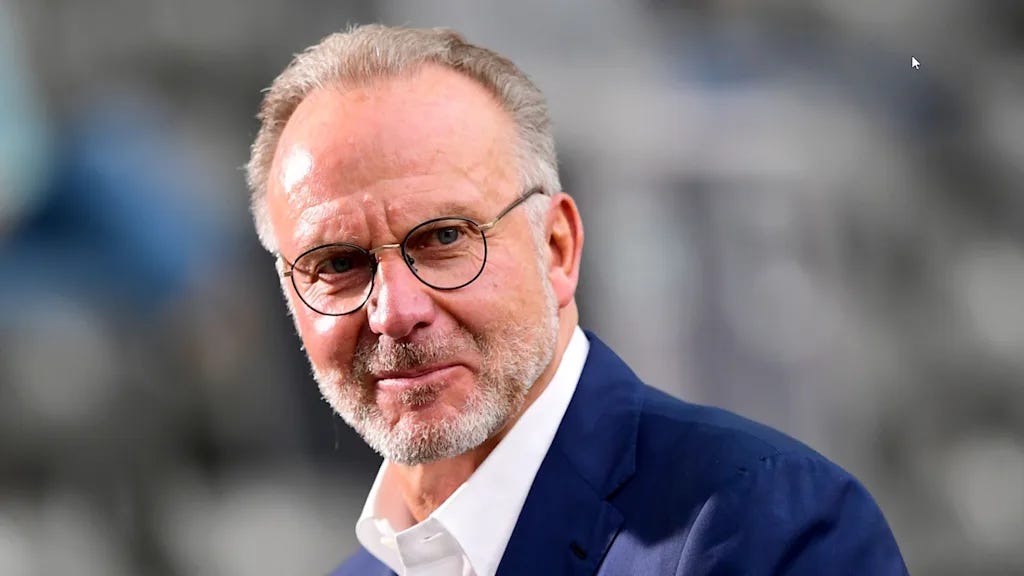
There are players whose careers are remembered for a single trophy, a single goal, a single unforgettable night. Karl-Heinz Rummenigge, who turns 71 today, deserves better than that kind of shorthand. For a decade at Bayern Munich and then across two World Cup finals with West Germany, he was one of the most complete forwards European football produced, quick enough to run past defenders, sharp enough to finish from angles that should not have worked, and durable enough to do it for club and country year after year.
Born in Lippstadt on 25 September 1955, Rummenigge began his career the unglamorous way, coming through amateur side Borussia Lippstadt before Bayern paid a modest fee to take him to Munich in 1974. Nobody could have known then that they were signing a player who would go on to win the Ballon d’Or twice, captain his country in successive World Cup finals, and eventually run the club that gave him his start.
Bayern’s Golden Years and the Breitnigge Partnership
Rummenigge arrived at Bayern just as the club was completing a hat-trick of European Cups, and while he was too young to be a central figure in the 1974 triumph, he was part of the squad that beat Saint-Étienne in the 1976 final to make it three European Cups in a row. An Intercontinental Cup followed that same year against Cruzeiro, giving the young forward silverware before he had even turned 21.
It was under coach Pál Csernai from 1979 onwards that Rummenigge truly became the player football remembers. Alongside the veteran Paul Breitner, he formed a striking partnership so effective that Bayern supporters simply merged their names into one word: Breitnigge. Rummenigge topped the Bundesliga scoring charts in 1979-80 with 26 goals and again in 1980-81 with 29, helping Bayern to back-to-back league titles in those two seasons and further domestic cups either side of them. He was named to the Bundesliga’s official team of the season for seven consecutive years, a run that tells you everything about how consistently dangerous he was.
Individually, those were the years that defined him. German Footballer of the Year in 1980, European Footballer of the Year the following season, and the Ballon d’Or itself in both 1980 and 1981. Few German forwards before or since have dominated a two year spell so completely, and by the time he left Bayern in 1984 he had scored 220 goals in 424 appearances across all competitions, numbers that still hold up brilliantly against anyone the club has produced.
Heartbreak in Two World Cup Finals
If Bayern shaped Rummenigge as a player, it was the West Germany shirt that defined his legacy. He won 95 caps and scored 45 goals between 1976 and 1986, and was part of the side that won the European Championship in 1980, beating Belgium in the final and earning a place in the tournament’s team of the year for his efforts.
The World Cups, though, are where his story turns bittersweet. At Spain 1982 he was sensational, scoring a hat-trick against Chile in the group stage and then the extra time goal that finally broke France’s resistance in one of the greatest semi-finals ever played. He finished that tournament with the Silver Boot and the Bronze Ball, and captained West Germany in the final itself, only to lose to Italy in Madrid.
Four years later in Mexico, now wearing the armband as established captain, he led West Germany back to another final, this time against a Diego Maradona-inspired Argentina. Rummenigge scored in the 3-2 defeat, but once again finished on the losing side. It left him with the unusual and slightly cruel distinction of having captained his country to two World Cup finals without ever lifting the trophy itself, a record that says as much about the brilliance of the teams he faced as any shortcoming of his own.
Inter Milan, Servette, and Life After Playing
In 1984, at 29, Rummenigge became one of the most expensive players in the world when Inter Milan paid a record fee to take him to Serie A. The move produced flashes of his old brilliance and a place in Italy’s team of the year in 1985, but persistent injury problems meant he never quite recaptured the consistency of his Bayern peak across three seasons at San Siro. A final chapter in Switzerland with Servette followed, and typically for a player of his quality, he still had enough left to finish as the Swiss league’s top scorer in his last season before retiring in 1989.
What came next may end up mattering just as much as what he did on the pitch. Rummenigge returned to Bayern as vice president in 1991 and eventually became chairman of the club’s executive board in 2002, a role in which he oversaw the move to the Allianz Arena and helped turn Bayern into one of the best run clubs in world football before handing over to Oliver Kahn in 2021. He also chaired the European Club Association for nearly a decade, giving him a genuine seat at the table when the modern game’s biggest decisions were being made.
Seventy one today, Rummenigge remains one of those rare figures whose influence on the sport did not end when his playing boots came off. Bayern fans who watched Breitnigge terrorise the Bundesliga, and West Germany supporters who twice believed the World Cup was coming home only to see it slip away, will know exactly why his name still carries the weight it does.
If pieces like this are your kind of football writing, the sort that goes looking for the stories behind the stories, consider following It Was Always… Football for more.