

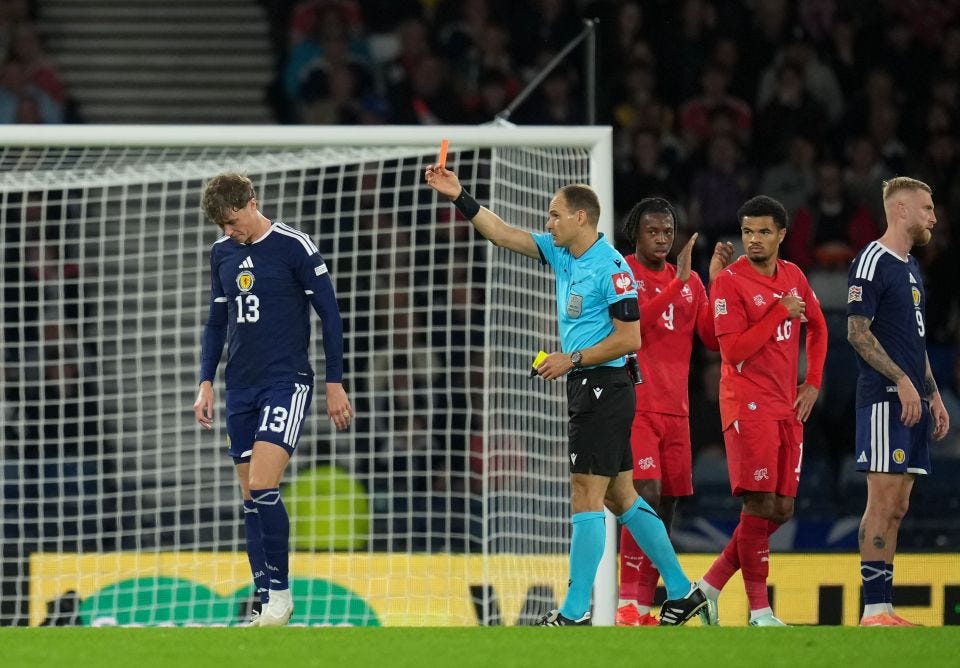
Sebastien Pocognoli wanted his first night at Hampden Park to feel like the start of something. Instead, inside eleven minutes, it turned into an exercise in damage limitation, and Scotland’s new head coach left with a 3-0 defeat to Switzerland that had rather more to do with a contentious red card than anything his players did wrong.
The visitors arrived at Hampden on Tuesday evening as Group B1’s form side and left with maximum points from two matches, but for long spells this was not the one sided occasion the scoreline eventually suggested. Scotland spent almost the entire game with ten men after Jack Hendry was sent off inside the opening quarter of an hour, and what followed was as much a story of resilience against the odds as it was a chastening result for a manager still finding his feet in the job.
A Contentious Red Card Changes the Game
The incident that shaped the evening came in the ninth minute. Nottingham Forest winger Dan Ndoye burst clear in behind the Scotland defence, and Hendry stuck out a leg to stop him inside the box. The referee’s first instinct was to award a penalty and show a yellow card, but a VAR review decided the contact had actually happened fractionally outside the area. The penalty was scrapped in favour of a free kick, yet the officials still judged that Hendry had denied a clear goalscoring opportunity, and the yellow card was upgraded to red.
It left Scotland facing the best part of eighty minutes with ten men, and Ricardo Rodriguez made the punishment count immediately, curling the resulting free kick beyond Angus Gunn to put Switzerland ahead inside twelve minutes. Pocognoli was booked himself just before the break for remonstrating with officials, a sign of how much the decision rankled inside the Scotland technical area, but he was measured about it once the dust had settled. “The red card of Jack is all of our red card. We stay together,” he said afterwards, refusing to let his young defender carry the blame alone.
Switzerland Punish Their Numerical Advantage
For all the anger over the sending off, Scotland’s response to going down to ten men was where this performance earned some credit. Andy Robertson, winning his 99th cap, said the game plan had to be torn up the moment Hendry walked. “We wanted to be good on the ball and press them higher up, but when you go a man down against a quality team, unfortunately you have to rip that up and try something else,” he explained. For the best part of an hour after Rodriguez’s opener, Scotland did exactly that, dropping deeper, defending in numbers and giving little away.
It held until just after the hour mark, when Nico Elvedi rose to double Switzerland’s lead in the 55th minute, and Zeki Amdouni added a third with twelve minutes remaining to put a scoreline on the game that felt harsher than the balance of the contest for long periods. Ndoye, so central to the opening goal, was a persistent threat throughout and looked every bit the player currently attracting admiring glances from watching scouts. Robertson was blunt about the toll the extra man eventually took. “The lads looked tired, and rightly so with how much effort we put in,” he said. “It’s a difficult night but we won’t let it get in the way of our process. We’ve got a new manager and a new squad and we have to still be positive.”
A Familiar Problem in Front of Goal
Buried beneath the red card storyline is a statistic that will worry Pocognoli just as much in the coming weeks. Scotland have now gone four consecutive matches without scoring, their longest drought in front of goal since 1971. It followed a goalless draw away to Slovenia on his managerial debut, when Oli McBurnie and Robbie Ure both went close without finding a way past Jan Oblak, and Tuesday’s numerical disadvantage meant there was little opportunity to address it. Even before Hendry’s dismissal, Scotland had struggled to build the kind of pressure that troubled Slovenia after half time in Ljubljana, and once they were down to ten men, the priority shifted entirely to keeping the score respectable rather than chasing an equaliser.
Pocognoli reflected on the emotion of a difficult evening in his first home match in charge. “I had a warm welcome and that made me a little bit sad because we wanted to give something back,” he said, acknowledging the backing from the Hampden crowd despite the circumstances. It is the kind of night that can define an early managerial reign if not handled carefully, and the Belgian, appointed in August after Steve Clarke’s departure following the World Cup, now has a fortnight to show his side can respond.
The Group Picture and What Comes Next
The defeat leaves Scotland third in Group B1, still without a win from two matches and with a single point to their name after that opening draw in Slovenia. Switzerland sit top with two wins out of two and a goal difference of plus six, while Slovenia are second after beating North Macedonia, who remain bottom without a point from their opening pair of fixtures.
Scotland’s response comes quickly. They travel to face North Macedonia on Saturday, a match that now carries real significance if Pocognoli’s side are to avoid finishing the group with real pressure attached, before hosting Slovenia again at Hampden the following Tuesday. Both fixtures represent an opportunity to put right what went wrong against the Swiss, against opposition Scotland will consider winnable on paper regardless of Tuesday’s scoreline. Robertson, for one, sounded like a captain ready to draw a line under it. Getting Scotland scoring again, and finding a first win of the Pocognoli era, will be the priority when they land in Skopje this weekend.
It Was Always… Football will keep bringing you Scotland’s story through this campaign and everything else moving across the English, Scottish and European game. If that sounds like your kind of read, stick around and subscribe.