

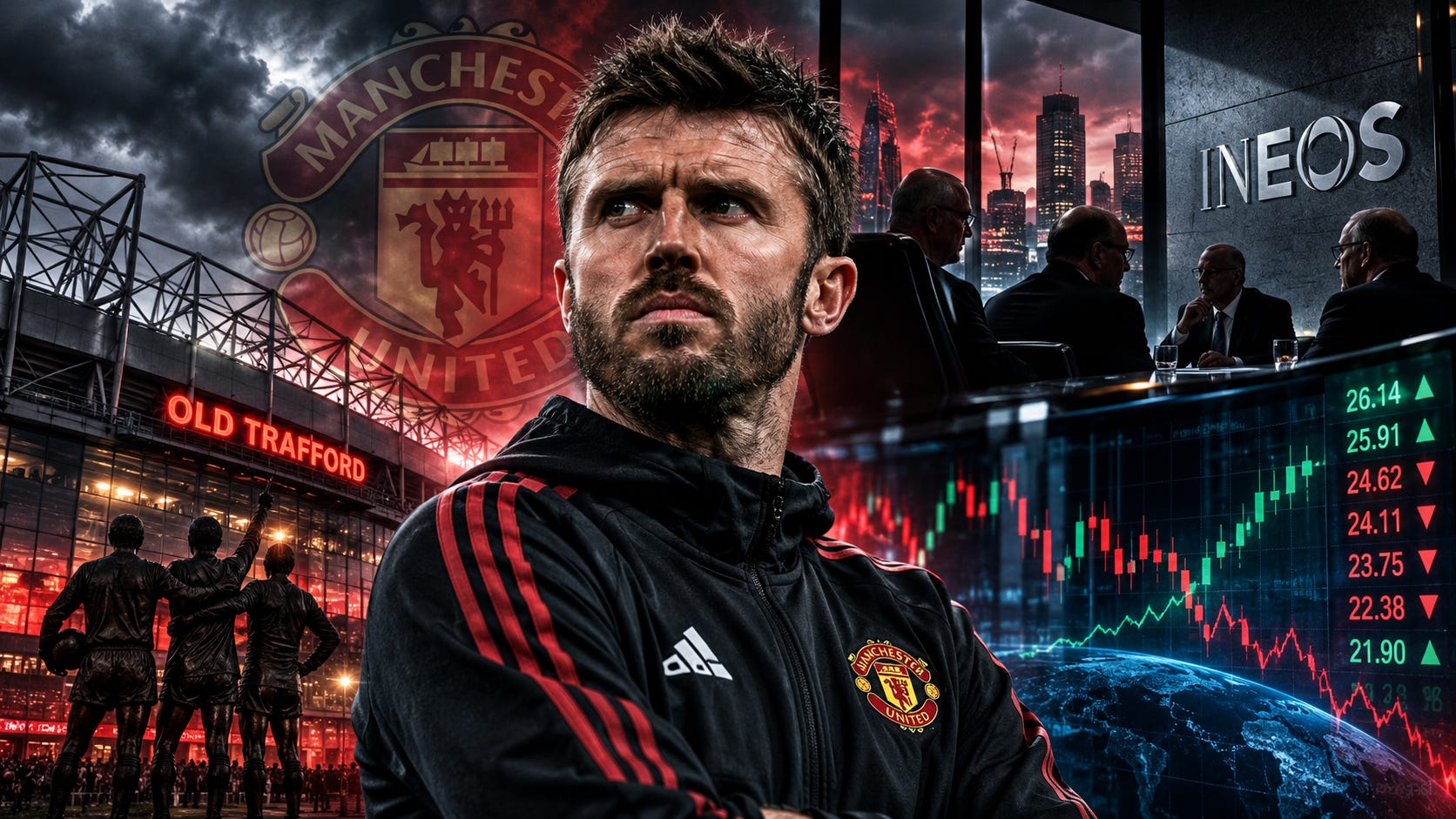
Michael Carrick woke up on Monday morning as Manchester United’s head coach. By the time he went to bed, remarkably, he still was. Twenty four hours earlier, Old Trafford had watched his side lose 3-0 to Bournemouth, a result that stretched an already alarming run to eight matches without a win in all competitions and left United 16th in the Premier League with seven points from eight games, by several reckonings their worst start to a league season since 1986.
By full time on Sunday, the consensus inside and outside Old Trafford was that Carrick’s position had become untenable. Gary Neville and Jamie Carragher both said as much on Sky Sports, with Carragher going as far as suggesting Carrick should be relieved of his duties that same evening. Carrick himself walked a slow lap of the pitch applauding supporters, a gesture widely read as a farewell. Asked about it afterwards, he pushed back, telling Sky Sports that was not what it had been about, describing his feelings as mixed and saying he simply needed time to take in the reaction from the stands.
What followed was not the swift, decisive sacking many had expected, but something stranger: a club that appeared to have made up its mind, unable to say so out loud.
A hierarchy talking without him
On Monday, Manchester United’s senior leadership gathered at the club’s Carrington training complex for what were widely described as crunch talks on Carrick’s future. Chief executive Omar Berrada, director of football Jason Wilcox and head of recruitment Christopher Vivell were all involved in those discussions. Carrick was not. He arrived separately that afternoon, at around 1.50pm, to watch an under-21 friendly against Hull City, a reason for being at the training ground that nobody seriously believed was his only one.
It capped a miserable few days that had begun the previous Wednesday, when United lost 4-1 at Como in the Champions League. Bruno Fernandes, the club’s captain, used an interview with Sky Italia afterwards to suggest that managers and coaching staff needed to make bolder in-game changes, comments widely interpreted as criticism of Carrick himself. Carrick’s response was blunt: Fernandes was left out of the squad entirely for the Bournemouth game, unused for the full 90 minutes while United collapsed around him. It is not the first sign of discontent from the dressing room either. Earlier this month, after the Como defeat, defender Lisandro Martinez was asked whether Carrick had felt backed by the club’s hierarchy. “I don’t think so,” he said. “He did his best. I expect more from our technical director, I have to be honest,” a remark that, without naming anyone, was read as a pointed message towards Wilcox.
Why the silence has been deafening
The explanation for Monday’s non-announcement turns out to have little to do with football at all. Manchester United is listed on the New York Stock Exchange as a foreign private issuer, which means a change at head coach level is treated as potentially material information for investors, the kind of development that has to be disclosed to the market in the correct manner before the club can say anything publicly. With the NYSE closed over the weekend, United were left unable to formalise a decision even if they wanted to announce it the moment Carrick left the pitch on Sunday. It is a near repeat of what happened in January, when Ruben Amorim’s sacking followed the same disclosure process before being confirmed.
That bureaucratic delay has bought Carrick time, whether or not it buys him his job. By Tuesday morning, The Athletic’s Manchester United correspondent Laurie Whitwell reported that Carrick was expected to take first team training as normal, with the club yet to communicate any change in his status. Against the expectations of Monday, he survived the day. Whitwell’s reporting suggests his chances of still being in the dugout for this Saturday’s trip to Chelsea are increasing, even as the hierarchy continues to quietly map out what comes next regardless of how long he stays.
It is worth remembering how recently the mood around Carrick was calmer. As late as the final weekend of September, Fabrizio Romano reported that the club “maintain their confidence in Michael Carrick,” insisting there had been no contact made with other coaches and that United hoped the situation would stay settled “for the next weeks and, they hope, months.” Six weeks on, with United winless in eight and dumped out of the Carabao Cup, that confidence has evaporated almost entirely.
The queue already forming
Whatever the timing of Carrick’s exit, United’s hierarchy are not waiting to start planning for life without him. Eddie Howe, out of work since leaving Newcastle in the summer, is understood to be Wilcox’s preferred option, a reflection partly of his Premier League record and partly of simple economics: as a free agent, he costs nothing to prise away from another club. Howe took Bournemouth into the Premier League and kept them there across five seasons, before leading Newcastle back into the Champions League twice and ending a 70 year wait for a domestic trophy with victory in the 2025 Carabao Cup. Reports suggest he is ready to return to management for the right opportunity, and few jobs come bigger than this one.
He is not the only name under consideration. Unai Emery has admirers inside the club too, though Aston Villa’s reported compensation demands, in the region of £20million, make him a considerably more expensive option than Howe. Antonio Conte has also been linked, though his well known desire for control over transfer recruitment sits awkwardly with a regime built around Wilcox and Vivell’s say on signings. Julian Nagelsmann, the former Bayern Munich and Germany coach, is said to be Vivell’s own preference, which hints at a quiet difference of opinion within the recruitment department itself over who should come next.
For now, none of it is resolved. Carrick remains the man taking training, the man expected to pick the team against Chelsea, and the man whose future is being decided by people who did not invite him into the room where that decision is being made. Few situations in English football right now capture quite how messy a modern managerial sacking can become, caught somewhere between a football decision and a regulatory one.
There is a version of this story that ends with Carrick given the rest of the season to turn things around, just as there is one that ends with Howe or another name unveiled before the weekend is out. Either way, it is a story worth following closely, and this will not be the last word on it.
If you enjoy coverage like this, consider subscribing to It Was Always… Football for more on the stories shaping the game, old and new.