

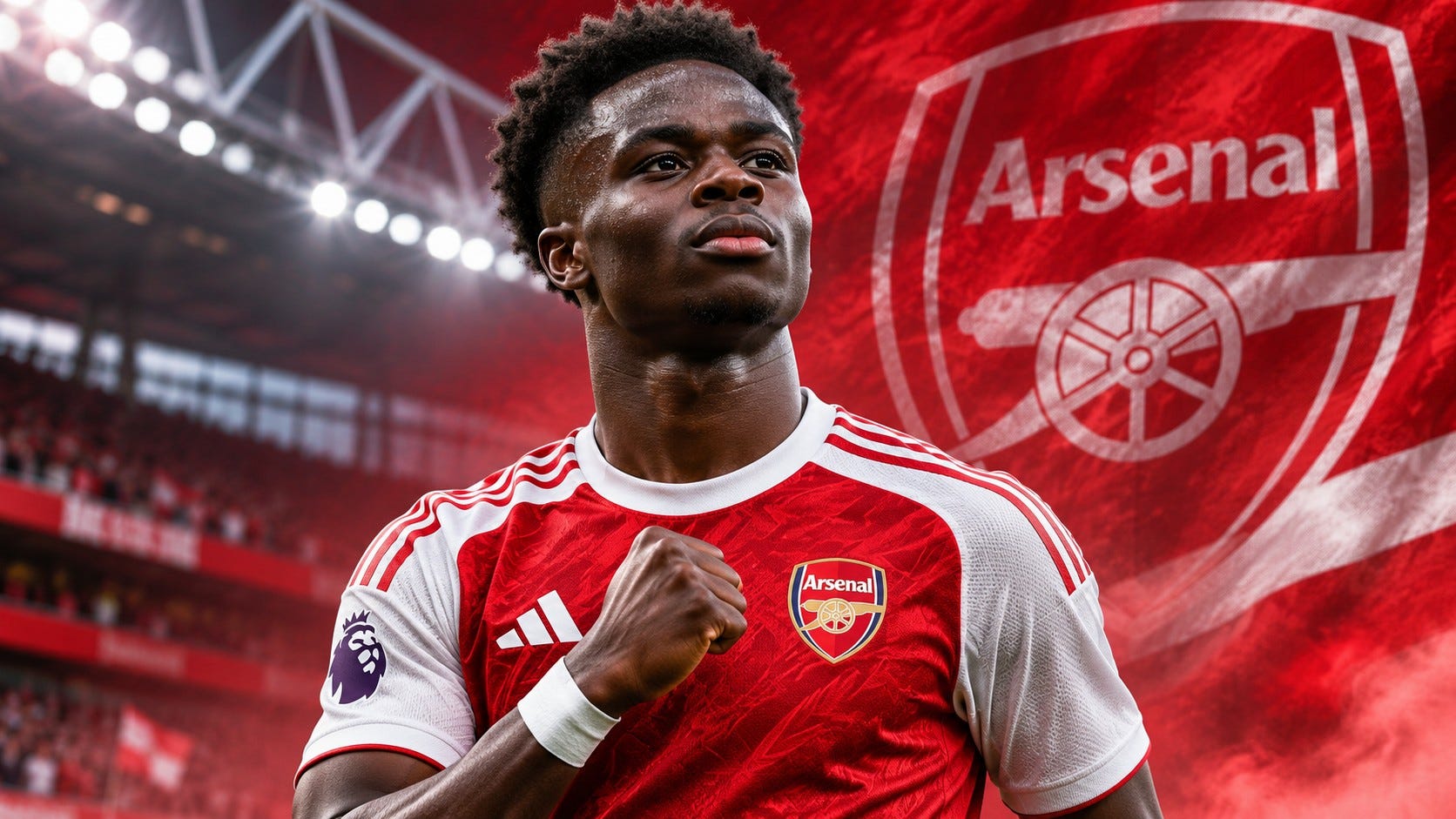
Arsenal have not had Bukayo Saka available since the final week of October, and somehow they have barely noticed. Three matches without him, three wins, and a position at the top of the Premier League that looks healthier with every passing week. The question now is not whether Arsenal can cope without their best player. They clearly can. It is whether they will have him back by the one date that matters more than any other on their winter calendar.
That date is the 29th of November, when Manchester City visit the Emirates in what already looks like the most eagerly anticipated fixture of Arsenal's season so far. Almost everything connected to Saka's recovery, from Mikel Arteta's carefully chosen words to the exact week he resumes full training, comes back to whether he will be fit enough to play some part in that one.
Saka was substituted early in Arsenal's 2-2 draw at Bayern Munich in the Champions League on 21 October, holding his quad and clearly in discomfort. What followed has been a slow and occasionally frustrating diagnosis. Early fears centred on an absence that could stretch anywhere from six to eight weeks, with Arsenal's medical staff delayed in getting a full picture of the damage by fluid build-up around the injury site, meaning follow-up scans took longer than hoped to deliver a clear timeline.
Mikel Arteta has been consistent in refusing to put a specific number on it. "We're talking about weeks," he said, sticking firmly to generalities rather than giving false hope. Pushed again more recently, he added that Saka "is going to be out for a while" and that any meaningful return to full training would not begin until after the international break. Saka, by all accounts, has not found the waiting easy. He is, in Arteta's words, "desperate to get back with the team," even if the manager is equally clear that "it's still quite early" to be talking about a return date with any confidence.
What Arsenal have done in the meantime is simply keep winning. A 2-0 win over Everton at the Emirates kept them level at the top of the table. A 1-0 win away at Liverpool, courtesy of a Kai Havertz strike that ended a 14 year wait for an Arsenal league win at Anfield, put them three points clear. Then, at home to Hull City before the international break, a second-half winner from captain Martin Odegaard settled it again and stretched that advantage further still. None of it has needed Saka on the pitch, and the defence behind the attack has been among the most reliable in the division all season.
Why the timing matters more than the injury itself
This is where it gets interesting, because the date Saka returns to full training is far less important than the date he returns to full match sharpness. Work it through using Arteta's own six to eight week estimate from the night of the Bayern Munich game, and the picture becomes clear fairly quickly. Six weeks takes you to the start of December. Eight weeks takes you much closer to the middle of the month. Add on the time any player needs after a lengthy injury layoff to rebuild match fitness, rather than simply being passed fit to train, and it becomes difficult to see a route back that has Saka ready much before early December at the very earliest.
That matters enormously, because Arsenal's fixture list after the international break reads like a run designed to punish anything less than full strength. They go to Newcastle first, then host Borussia Dortmund in the Champions League, before the single biggest match of their winter: Manchester City's visit to the Emirates. On the numbers above, Saka being fit for that one looks like a stretch too far, whichever end of the original recovery estimate turns out to be accurate.
The games that could decide whether he is ready in time
After City come Brentford away, then a trip to Tottenham, a Champions League visit from Real Madrid, Bournemouth at home and finally Manchester United before Christmas. Somewhere inside that run sits the more realistic window for Saka's actual return, whether that ends up being the Tottenham fixture in the first week of December or, if the more cautious estimate proves correct, closer to the Manchester United game just before the festive period.
None of this is a complaint from Arsenal's side, and it should not be read as one. A club sitting comfortably clear at the top of the table, with one of the division's most reliable defensive records behind them, is in about as strong a position as any to be patient with its most important forward, rather than rushing him back the moment he is cleared to train. Arteta has shown little appetite for gambling with Saka's fitness in the past, and there is no obvious reason he would start now, particularly with a title defence still very much to be won rather than a position to be merely protected.
A lead built without him, not in spite of him
What should give Arsenal supporters genuine confidence is that none of the last three results have felt remotely fortunate. Beating Everton comfortably, winning away at Liverpool for the first time in years, and grinding out a win against a well organised Hull side are three different tests answered three different ways. The uncomfortable truth for the rest of the Premier League's chasing pack, City included after their own recent wobble, is that Arsenal's best player has not even been part of it.
When Saka does return, whether that is for the Tottenham game, the Manchester United visit, or somewhere in between, he will be walking back into a side playing with real conviction rather than one desperate for him to paper over the cracks. For a club with serious ambitions this season, that is a far healthier problem to have than the alternative.
There is plenty of football still to come before anyone needs reminding why Saka's return matters so much. For now, the table does the talking, and it is doing so rather eloquently without him.
If you enjoyed this, consider subscribing to It Was Always... Football for more on the stories shaping the season.