


The World Cup has always been a stage for football’s greatest moments. This summer, it may also become the testing ground for some of the most significant law changes the sport has seen in decades.
While supporters will naturally focus on the players, the stadiums and the stories that emerge across North America, FIFA’s refereeing department has been quietly preparing a series of measures designed to tackle some of football’s most frustrating habits.
Time wasting, prolonged substitutions, questionable VAR limitations and poor player behaviour have all come under the microscope.
The aim is simple. Keep the ball in play more often, reduce controversy where possible and make the game flow better.
Whether supporters agree with every change is another matter entirely.
The War on Time Wasting Intensifies
Anyone who has watched football over the past few seasons will know exactly where FIFA’s frustrations lie.
Goalkeepers taking an age over goal kicks. Players strolling towards the touchline when substituted. Endless delays that slowly drain momentum from matches.
The governing body believes stronger deterrents are needed.
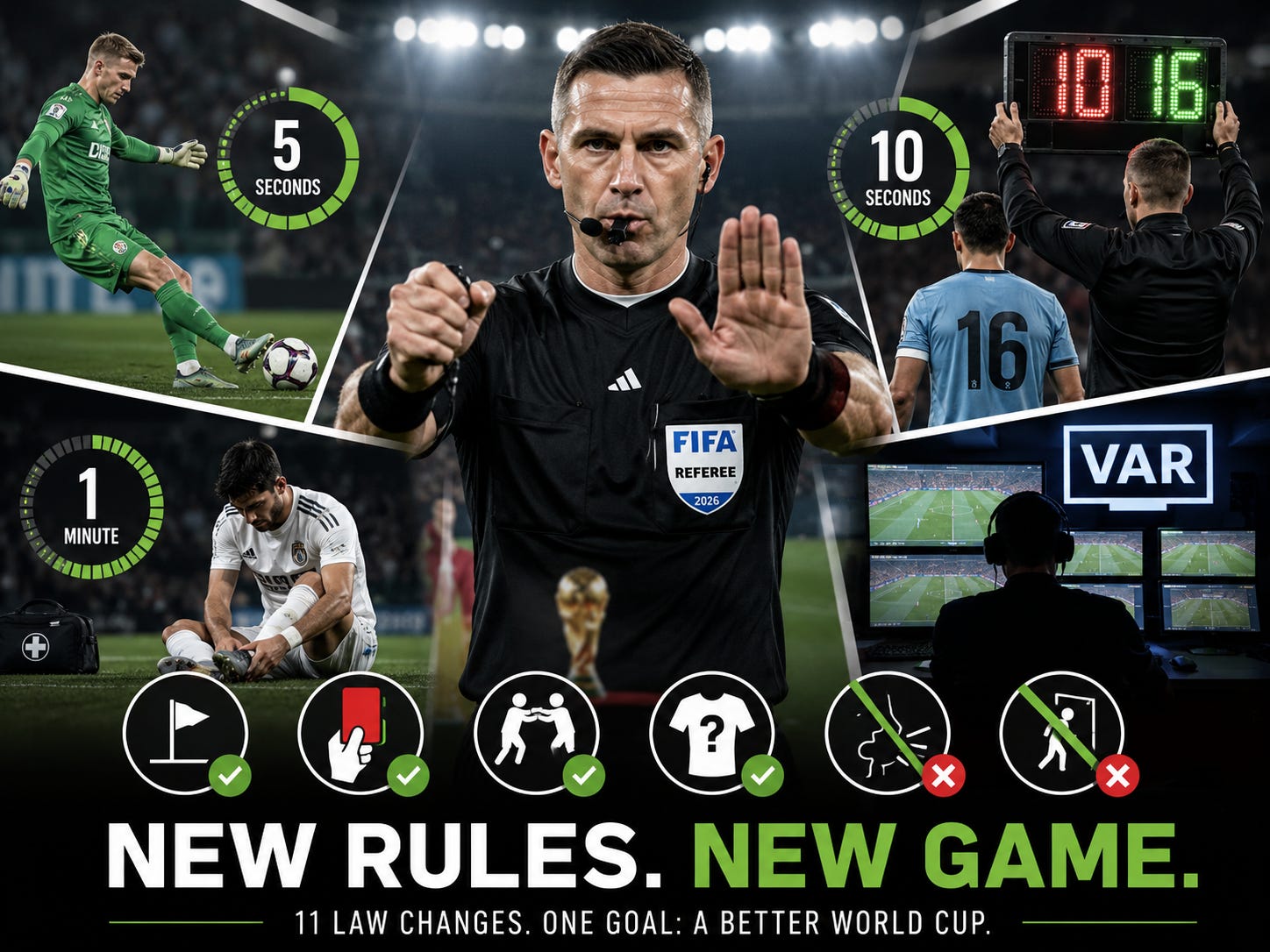
Under the new World Cup regulations, referees will be able to introduce visible countdowns for delayed restarts.
If a player deliberately wastes time over a goal kick or throw in, there could be serious consequences. A delayed goal kick could be converted into a corner kick for the opposition, while a delayed throw in could be handed to the other team.
That represents a far greater threat than a yellow card.
For years, players have accepted cautions as part of game management. Conceding a corner in the closing moments of a match is a punishment that could directly influence the result.
It is clear what FIFA hopes will happen.
Players will simply stop testing the limits.
Substitutions Could Suddenly Become Riskier
Another major adjustment concerns substituted players.
The instruction is straightforward. Leave the pitch quickly.
Players will now have just ten seconds to exit at the nearest point.
Fail to do so and the incoming substitute will not be allowed onto the field immediately. The replacement must wait until play stops again, meaning teams could temporarily find themselves down to ten men.
That may sound harsh, but FIFA believes the possibility of playing short handed will eliminate deliberate delays.
A recent international friendly between Japan and Iceland provided an early example of how it works. Iceland briefly played with ten men after a player took too long to leave the pitch, and Japan scored before the next stoppage arrived.
Expect managers to be reminding their players about this constantly.
Injured Players Will Wait Longer Before Returning
Supporters in Britain have already become accustomed to players spending a short spell off the pitch after receiving treatment.
That waiting period is now being doubled.
If medical staff enter the field to treat a player, the player will generally be required to remain off the pitch for one full minute before returning.
The change extends beyond the World Cup and will be adopted more widely across football.
There are exceptions.
Goalkeepers, serious injuries, head injuries, collisions involving goalkeepers and situations where an opponent receives a disciplinary sanction will all be treated differently.
Even so, the adjustment is likely to generate debate.
Critics argue genuinely injured players may hesitate before requesting treatment. FIFA believes the benefit of reducing tactical stoppages outweighs that concern.
Has FIFA Finally Targeted the “Tactical Injury”?
One of football’s most discussed modern tactics has been the sudden goalkeeper injury.
We’ve all seen it.
A team is under pressure. The goalkeeper goes down. The physio arrives. Players gather around the technical area. Instructions are delivered. Momentum disappears.
FIFA has not completely eliminated the tactic, but it is attempting to reduce its effectiveness.
During goalkeeper treatment breaks, players will no longer be permitted to use the opportunity to gather around coaches for impromptu tactical discussions.
Whether this proves enforceable remains to be seen.
The tactic itself may still exist. The organised team talk may not.
VAR Is About to Get Even More Involved
For supporters who already feel VAR occupies too much space in football, there is further expansion on the horizon.
The system will receive additional powers in several specific situations.
Corner Kick Reviews
VAR officials will be permitted to check whether a corner kick has been awarded correctly.
The expectation is that technology and existing delays before corners are taken will allow these checks without creating additional stoppages.
Interestingly, the same principle will not automatically apply to goal kicks that should have been corners.
Second Yellow Card Reviews
Players dismissed following a second yellow card will receive additional protection.
VAR will be able to intervene if the second caution stems from a clear refereeing error.
Importantly, this is not intended to create endless reviews over subjective decisions. The threshold remains high.
Off The Ball Incidents Before Corners
One particularly interesting addition concerns fouls before the ball enters play.
Previously, incidents occurring before a corner was taken often escaped VAR scrutiny.
Now, if an attacking infringement directly leads to a goal, penalty or disciplinary action, VAR can intervene.
This closes a loophole that has frustrated officials for years.
Mistaken Identity Corrections
Rare though it may be, referees occasionally punish the wrong player.
Under the new framework, VAR can help correct cases where a booking or dismissal is shown to the incorrect individual.
It may not happen often, but when it does, the consequences can be significant.
Tougher Sanctions For Player Conduct
The final group of changes focuses on behaviour.
FIFA wants to stamp out certain forms of confrontation before they become larger problems.
One notable addition allows referees to dismiss players who cover their mouths while engaging in confrontational exchanges.
The intention is clear. FIFA believes players attempting to conceal abusive or discriminatory language should face severe consequences.
Another potential red card offence involves players leaving the field specifically to protest refereeing decisions.
The move follows several controversial incidents around world football where matches were disrupted by collective protests and refusals to continue play.
FIFA wants stronger tools available before similar situations occur on the sport’s biggest stage.
A Different World Cup Awaits
The 2026 World Cup was already set to be unique.
More teams. More matches. More host cities.
Now it will also showcase a radically different refereeing landscape.
Some of these changes may disappear after the tournament. Others could become permanent features across domestic football in England, Scotland and beyond.
What seems certain is that football’s lawmakers believe the game has reached a point where stronger intervention is necessary.
The next twelve months will reveal whether supporters agree.
One thing is guaranteed.
Referees will have plenty more to think about when the World Cup finally gets underway.