

Manchester City left Old Trafford with all three points and Manchester United left it with a genuine sense of injustice. Erling Haaland’s second half winner settled a bad tempered Manchester derby that City spent the majority of playing with ten men, and by full time the story of the afternoon was not the football but the officiating.
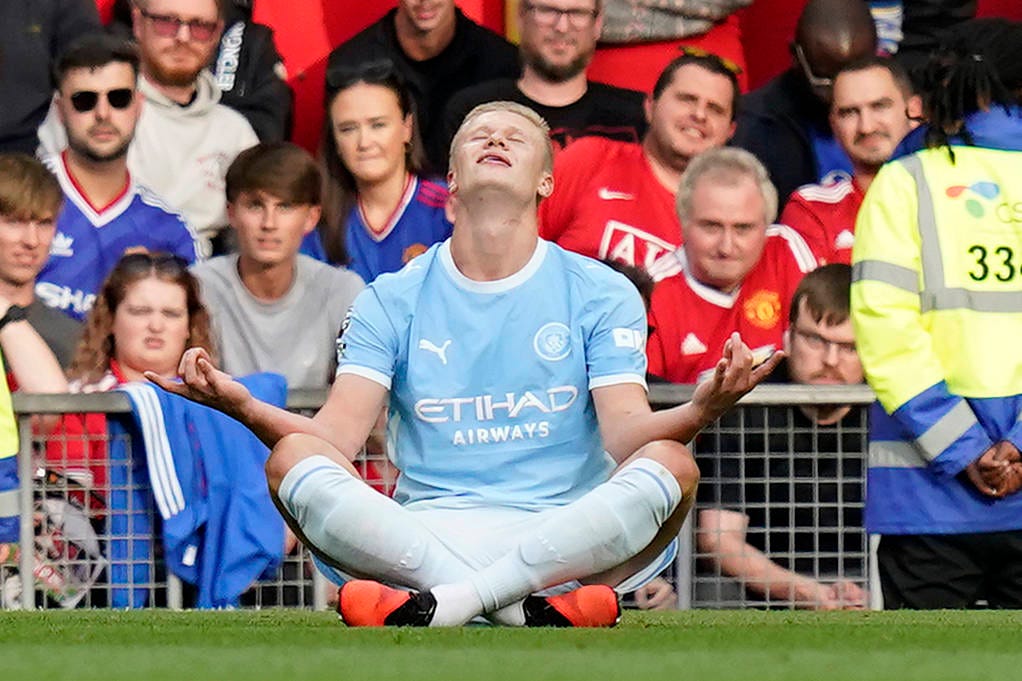
It was billed in advance as the first head to head meeting between Michael Carrick and Enzo Maresca, two managers still shaping their sides in very different circumstances, and it lived up to that billing for all the wrong reasons. Phil Foden was sent off before half time, Marcus Rashford struck a post with a free kick that would have changed everything, and Haaland’s goal only stood after officials spent close to three minutes poring over the goal frame by frame. United were left with nothing to show for a performance that, numerically at least, should have been enough.
The red card that changed the shape of the game
The flashpoint came in the 23rd minute. Bruno Fernandes fouled Foden and, as the England winger got back to his feet, he kicked out towards the United captain’s body. The referee showed a straight red card for violent conduct, a decision VAR upheld after review, and City were down to ten men with more than an hour still to play.
It was the correct outcome by the letter of the law, but it was not a popular one. Roy Keane argued that Fernandes had escaped scot free for the original challenge, saying bluntly that Fernandes was the one who had been violent and that Foden’s reaction, while wrong, had been provoked. Micah Richards took a similar view, suggesting the incident looked worse than it was and that Fernandes had caught Foden first. Gary Neville also questioned why the United captain had avoided any punishment at all.
Maresca himself did not dispute the sending off after the game but made his feelings about the other side of the coin clear. Asked about the incident, he said it could be a red card in the same passage of play for Fernandes as much as for Foden. It changed City’s approach for the rest of the match, he admitted, just as much as it changed United’s.
Haaland’s winner survives a lengthy VAR review
Down to ten men, City set up to defend deep and hit United on the break, and it was exactly that pattern that produced the only goal of the game. Joško Gvardiol’s cross was flicked on and Haaland turned it home from close range in the 60th minute, but the celebrations were put on hold almost immediately as the assistant’s flag went up.
What followed was one of the longer VAR reviews of the season so far. Two City players were checked for their positions in the build up. Enzo Fernández had been in an offside position as the ball came across and appeared to attempt a diving header at it, but replays showed he made no contact with the ball, and officials ruled he had not interfered with play in a way that warranted the goal being chalked off. Haaland’s own position was then checked separately, and semi automated technology showed he had in fact been played onside by United defender Patrick Dorgu’s outstretched leg as he tried to intercept Gvardiol’s cross. On that basis, the goal stood.
Carrick’s reaction afterwards told you everything about how that explanation landed inside Old Trafford. He pointed out that United had a defender within inches of Fernández and questioned how that could possibly be read as no interference, calling it a staggering decision and adding that the explanation given afterwards made it worse rather than better. It is worth saying City’s own manager saw it rather differently. Maresca said he thought it was completely clear that Haaland’s goal was onside, and credited his players for adapting to circumstances that changed twice in the space of a first half.
United left to rue chances of their own
For all the focus on the officials, United will know they had the game there to be won. Rashford’s free kick from 30 yards clipped the outside of the post before half time, and City goalkeeper Gianluigi Donnarumma had to be alert late on to keep out a stinging effort from Bryan Mbeumo in stoppage time as United threw players forward in search of an equaliser. Carrick was careful afterwards not to be too critical of his players given the numerical advantage they held for so long, but he acknowledged that his side needed to have done more with the chances that came their way, particularly after Foden’s departure.
The result leaves City joint top of the Premier League on 12 points from their opening four matches, level with Arsenal and now unbeaten in four to start the new season under Maresca. It is a landmark result for the Italian in only his first taste of this fixture, secured despite losing a key player before half time and in one of the more testing atmospheres English football has to offer. For Carrick, it is a first defeat of the new campaign and a reminder of how fine the margins can be at this level. He was adamant afterwards that there is a long season ahead and that his side would recover quickly, and given how competitive United looked for large periods even with a man advantage, there is little reason for panic in Manchester just yet.
What both managers will hope for now is a quieter week. Neither City nor United will want the inquest into Sunday’s derby to run much longer than it already has, and both have European commitments to turn their attention to before the Premier League returns. The bigger picture, for now, is a City side finding a way to win even when the game is not going their way, and a United side still searching for the moment their promising form under Carrick translates into victory over one of their biggest rivals.
If you enjoyed this, consider subscribing to It Was Always… Football for more of the stories shaping the game, old and new.