

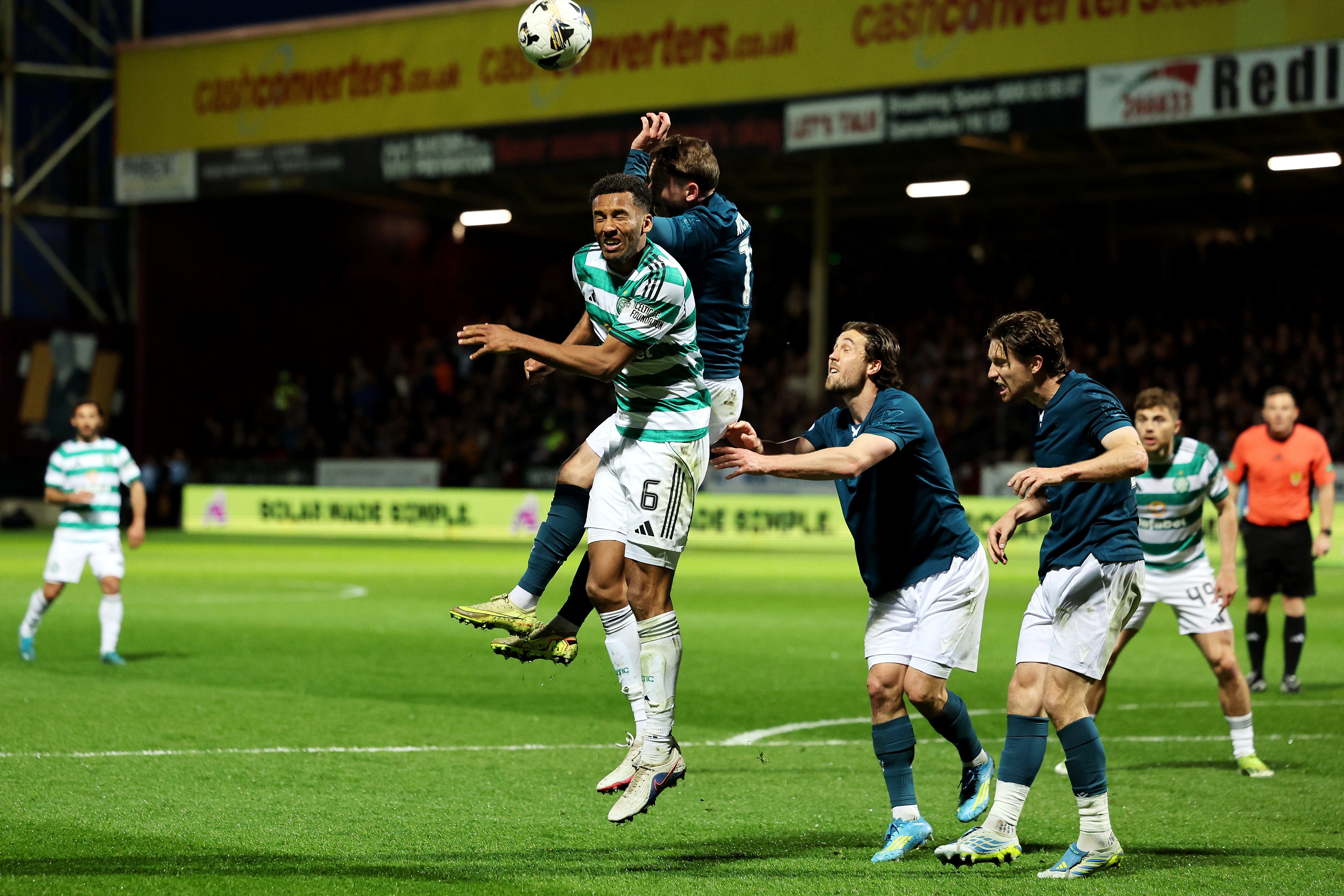
Scottish football had the perfect ending sitting in front of it. A title race alive into the final weekend, Hearts standing on the edge of history, Celtic forced to chase, tension pouring from every stand and every living room in the country.
Then came Fir Park, a raised arm, a blurry replay, a referee jogging to a monitor, and the familiar feeling that Scottish football had once again made itself look small.
By the time Kelechi Iheanacho rolled home the 99th minute penalty to beat Motherwell, the conversation had already shifted away from football. Nobody cared about Celtic’s recovery from 0-1 down. Nobody cared about the quality of the title race. Nobody cared that Hearts still control their own destiny.
Everybody cared about VAR.
That is the curse of the thing. It inserts itself into moments that should belong to players and supporters, then leaves behind a fog of anger, suspicion and tribal warfare.
And the worst part is this, I genuinely believe every side involved thinks they are right.
Tribal Scotland Shapes Every Decision
I have lived in Scotland long enough to understand one unavoidable truth. Even if you support neither Celtic nor Rangers, you usually lean emotionally toward one side of the divide.
When I first moved north and followed Raith Rovers religiously, it fascinated me how conversations before and after matches always drifted toward Celtic and Rangers. Results elsewhere shaped moods in pubs and terraces. Somebody always wanted one of them to lose. Somebody always wanted one of them to suffer.
It felt bizarre at first, then eventually it simply felt Scottish.
That culture matters when these controversies erupt because referees are not robots. VAR officials are not neutral machines floating above emotion and influence. They are products of the same football culture as everybody else.
One week, an official is accused of favouring Celtic, the next he is supposedly a Rangers sympathiser. Every big call becomes evidence for whichever side already distrusts him.
Do I think Scottish football is openly corrupt? No.
Do I think human beings carry natural bias and subconscious influence into massive moments? Absolutely.
That is precisely why VAR was sold to us as the answer. Technology was supposed to remove emotional error from the game. Instead, it has amplified every suspicion already bubbling beneath the surface.
Because once slow-motion replays become involved, football stops being instinctive and starts becoming interpretative theatre.
Clear and Obvious Has Become Meaningless
This is where the Celtic penalty becomes impossible to defend for many people, myself included.
Forget tribal allegiance for a moment. Forget who benefits. Forget the title race.
Ask the only question that matters.
Was there a clear and obvious error from the referee?
I cannot honestly say there was.
The original decision was no penalty. There was no furious Celtic appeal. No immediate uproar from players. No certainty inside the stadium. Then VAR intervenes, and suddenly everybody is expected to accept that an obvious injustice has occurred.
Where is the conclusive proof?
One blurry angle appears to show the ball glancing near Sam Nicholson’s hand, but another suggests it comes cleanly off his head. The trajectory of the ball itself raises doubt. The arm position can reasonably be argued as natural within the leap. There is also a legitimate argument that Auston Trusty’s challenge forces Nicholson’s arm upward in the first place.
This is not certainty. This is interpretation.
And that matters because VAR was never introduced to re-referee football through microscopic analysis. It was introduced to correct glaring mistakes.
If ten replays still leave millions arguing over whether the ball even touched a hand, then how can the intervention itself be justified?
That is the part many Celtic supporters either ignore or dismiss.
Even if the ball brushed a hand, the threshold for overturning the decision should still matter.
Otherwise we are simply refereeing matches twice.
Fury Was Always Inevitable
The reaction across Scotland was utterly predictable.
Celtic supporters largely saw a defender taking a risk with an arm raised high near the ball. Penalty. Simple.
Hearts supporters, Rangers supporters and neutrals saw something very different. They saw another contentious decision favouring the established power in Scottish football at the precise moment the league threatened to produce an outsider champion.
That perception matters whether Celtic like it or not.
The timing made it explosive. Had this happened in October, the outrage would have lasted a weekend. Happening in the dying seconds of a title race involving the first genuine challenger to the Glasgow duopoly in decades turned it radioactive.
And social media only deepened the madness.
Within minutes, people were circulating slowed-down clips, freeze frames and enhanced images claiming to prove either innocence or guilt. Some Celtic supporters even shared AI-generated stills supposedly proving handball, despite obvious flaws, including duplicated footballs and incorrect kit branding.
That is where modern football now lives. Not in certainty, but in digital propaganda.
Everybody arrives at the evidence already knowing what they want to believe.
The uncomfortable truth is that I probably do as well.
I want Hearts to win this title. I want Scottish football to experience something fresh. I wanted the old certainty shattered for once. That emotional preference undoubtedly shapes how I viewed the incident in real time.
Maybe Celtic supporters are correct when they argue everybody would react differently had Hearts received the same decision.
Perhaps.
But that still does not solve the central issue, which is that VAR has replaced one referee’s split-second judgement with another referee’s subjective interpretation from a television monitor.
The technology changes. The human element never disappears.

Scottish Football Has a Credibility Problem
This controversy arrives at the worst possible time for Scottish football because this has actually been one of the league’s most compelling seasons in years.
Hearts have disrupted the expected order. Celtic have looked vulnerable. Rangers have stumbled through another damaging campaign. There has been uncertainty, pressure and genuine jeopardy.
People outside Scotland have finally paid attention.
And now the loudest global conversation about the league revolves around whether the title race has been manipulated by incompetence.
That is deeply damaging.
Supporters of smaller clubs already believe the game bends toward Celtic and Rangers. Every contentious decision feeds that cynicism. Every vague VAR explanation intensifies it further.
Transparency remains dreadful. Rugby allows supporters to hear conversations between officials. Cricket explains decisions clearly. Football still behaves like an exclusive club protecting itself from scrutiny.
At Fir Park, confusion spread instantly because nobody fully understood what was being reviewed. Handball? Elbow? Both?
By the time the penalty was awarded, the atmosphere had curdled into disbelief.
The danger for Scottish football is not merely outrage from rival fans. Football survives outrage. It always has.
The danger is erosion of trust.
Once supporters begin believing outcomes are shaped by interpretation tailored toward powerful clubs, the credibility of the competition weakens. Not collapses, but weakens.
And Scottish football cannot really afford that.
Because beneath all the noise sits another uncomfortable reality. The standard on the pitch is not strong enough to carry the game globally on football quality alone. Too often, the league’s identity revolves around noise, rivalry and grievance rather than elite football.
That is why nights like this cut so deeply. Scottish football finally had an opportunity to market itself through unpredictability and genuine sporting drama.
Instead, VAR became the headline again.
Saturday Carries More Than a Title
Now we arrive at Celtic Park with everything on the line.
Hearts still need only avoid defeat to become champions. That fact should not be lost beneath the anger.
If they achieve it, this controversy may become a footnote swallowed by history.
If Celtic win the league, however, this decision will follow the title forever.
Fairly or unfairly, people will remember Fir Park before they remember the trophy lift.
That is the burden VAR creates. It stains moments that should otherwise belong entirely to football.
As for me, I still believe it was a dreadful intervention. I still believe there was nowhere near enough certainty for VAR to involve itself. I still believe the game looked ridiculous, trying to manufacture certainty from inconclusive footage.
But I also accept my own subjectivity.
That may be the most honest conclusion possible.
Scottish football is tribal. Referees are human. Supporters carry prejudice into every debate. VAR was supposed to rise above all of that.
Instead, it has trapped itself inside the same chaos.
And perhaps that was inevitable from the very beginning.