

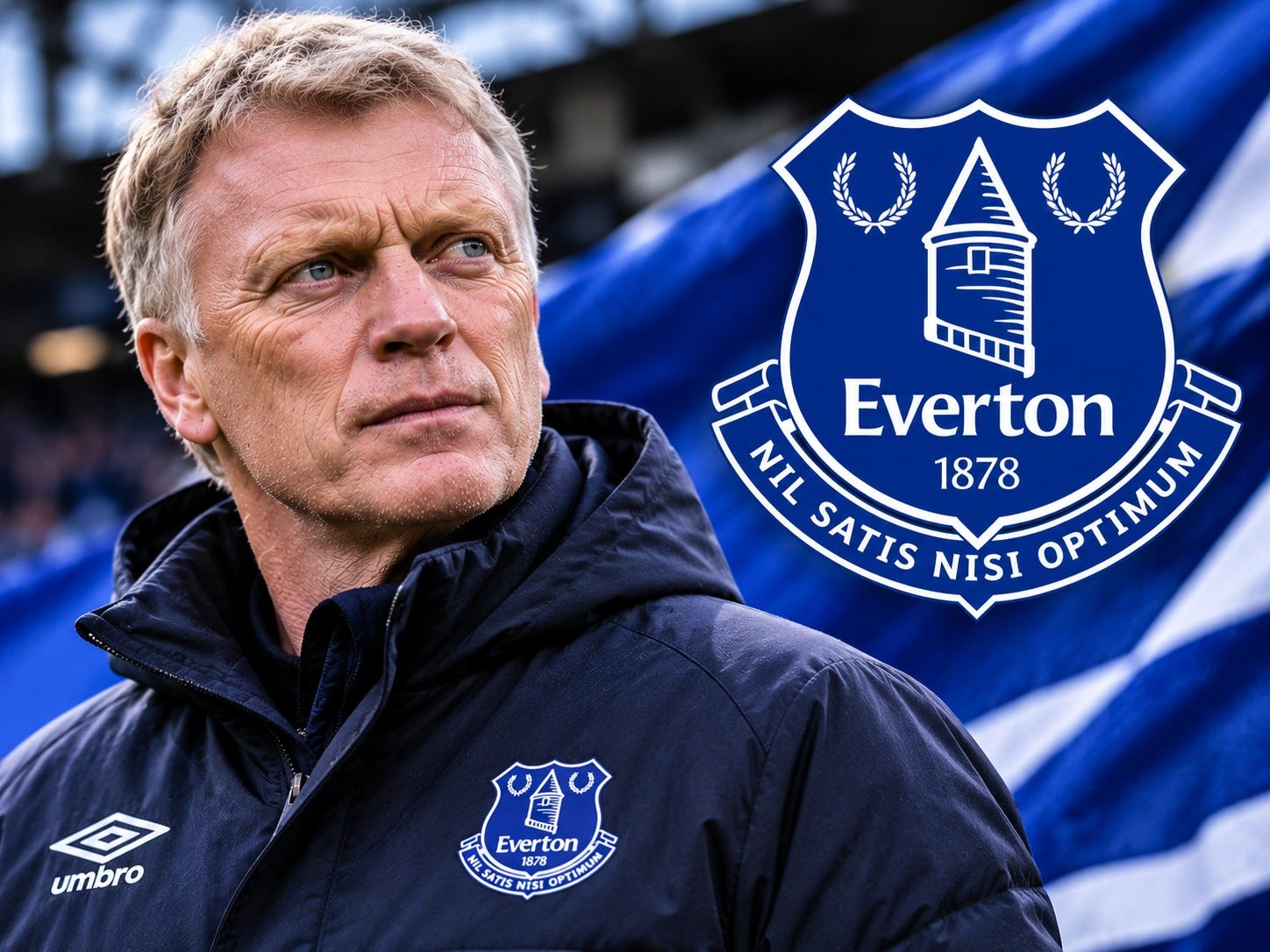
On a Friday night at the Hill Dickinson Stadium, with Coventry City providing the opposition just as they had for Harry Catterick's final game in charge 53 years earlier, David Moyes walked out for his 592nd match as Everton manager. That figure matches Catterick's own total from twelve years at the club, the most decorated spell in Everton's history, and it makes Moyes the only other man to reach it. Everton won 3-1, coming from behind through a Thierno Barry double and a goal from Kiernan Dewsbury-Hall, and Moyes allowed himself a rare moment to enjoy a landmark built up across a second spell that has not always been straightforward.
"The thought of being the Everton manager who has managed the most games is something I'm very proud of," Moyes said afterwards. "The Club gets you, and if you get the Club, then it's so big." It is a modest way to describe a milestone that puts him level with Catterick, the only man to deliver Everton two league titles, and ahead of Howard Kendall and Joe Royle among those who simply stayed the course on Merseyside the longest. Moyes will move clear of the record outright when Everton return from the international break away at Brentford on 23 November, a quiet landmark arriving at the same time as a season that has quietly turned into one of Everton's better ones in years.
A second spell that started from the wrong end of the table
Moyes' return in January 2025 came in unglamorous circumstances. The Friedkin Group, having recently completed its takeover of the club from Farhad Moshiri, sacked Sean Dyche after a run of five league games without a win in which Everton scored only once, leaving the club 16th and just a point above the relegation zone. Moyes had built his reputation during his first spell in charge, from 2002 to 2013, by making Everton competitive without the budget to match the clubs above them. The years that followed, at Manchester United, Real Sociedad, Sunderland and West Ham, were considerably less kind to that reputation.
Coming back two decades after he first walked through the door at Bellefield was, in truth, a job about stability rather than ambition. There was Premier League safety to secure, and there was a move away from Goodison Park to manage, with the club relocating to the new Hill Dickinson Stadium on the banks of the Mersey later that year. Both have been achieved. What has followed since has been something closer to the version of Everton supporters used to recognise: well organised, difficult to beat, and punching above a transfer budget that remains small by Premier League standards.
Why sixth feels earned rather than fortunate
Everton go into the international break sixth in the Premier League, with 16 points from ten games, four wins, four draws and only two defeats. It is a position built on defensive solidity rather than goals scored for fun, and on the emergence of Thierno Barry, who has scored freely since signing from Villarreal in the summer, including the double that settled the Coventry game. Kiernan Dewsbury-Hall and the returning Jarrad Branthwaite have both looked like players rediscovering their best form, while Hayden Hackney, signed from Middlesbrough, has slotted into midfield with little fuss.
It has not been entirely smooth. Jack Grealish, on a second consecutive season long loan from Manchester City, missed the win over Arsenal through illness and was then left out of the Carabao Cup tie against Newcastle for a breach of club discipline, with the Press Association reporting the issue related to an unauthorised absence from training. Moyes backed the decision to leave him out, and Grealish has since returned to the squad. That Newcastle tie, won 3-1, set up a Carabao Cup quarter final at home to Fleetwood Town in December, the League Two side who became the story of the competition by eliminating reigning champions Arsenal on penalties in October. Everton, for once, find themselves the favourites in a cup tie rather than the ones hoping for an upset.
An ownership question with no clear answer yet
All of this has happened against a backdrop that has little to do with results on the pitch. On 9 October, the Friedkin Group, the Texas based ownership group that bought Moshiri's majority stake in December 2024, confirmed it was exploring new investment options for Everton, including the sale of a controlling interest. The group's statement framed its time in charge so far as a period of stabilising the club's finances and helping deliver the new stadium, and said that with that foundation now in place, the time had come to weigh up a change of ownership. It gave no timetable, said it would only engage with buyers it considered suitable custodians of the club, and has made no further comment since.
There is an obvious tension in the timing. A club that spent much of the past decade fighting points deductions, managerial upheaval and the uncertainty of a stadium move is, for the first time in a while, being run well enough to sit in the top half of the table with a manager who has quietly become the most enduring figure in its history. That it should also be the moment its owners choose to look for an exit says something about how modern football club ownership works just as much as it says anything about Everton specifically. Supporters have seen takeovers drag on for years before, and whatever happens with the sale process, nobody at the club is promising it will move quickly.
For now, the football keeps the mood in a good place. Moyes has a Premier League table to point to, a quarter final to look forward to, and a record that will soon be his alone rather than one he shares with a man who left the job 53 years ago. Everton return from the international break at Brentford looking to build on all three, with the small matter of who actually owns the club by the time they do still very much unresolved.
If stories like this are your thing, It Was Always... Football is worth subscribing to for more of the same.